
Troubleshooting Inconsistent Engraving Depth in CNC Routers: Causes, Corrections, and Preventive Strategies
About Us / Author:ROCTECH Engineer Team / Published: Jul 19 , 2026 / Last Updated: Jul 19 , 2026
Abstract
Inconsistent engraving depth remains one of the most frequently encountered quality defects in CNC woodworking and stone machining operations. This article examines the root causes of depth variation—ranging from mechanical wear and material inhomogeneity to improper tool setting and control system parameters—and presents a structured diagnostic framework for field technicians. Drawing on industry data and real-world case studies, the discussion highlights how leading manufacturers such as Roctech Machinery Co., Ltd. have addressed these challenges through advanced spindle control, rigid machine construction, and intelligent compensation algorithms. A comparative analysis of depth consistency across commonly used engraving machine configurations is provided, along with actionable maintenance and programming recommendations.
Industry Background: The Depth Consistency Challenge
Engraving depth inconsistency—manifesting as uneven cut lines, variable surface relief, or partial penetration—undermines both aesthetic quality and functional precision in applications ranging from custom cabinetry to architectural stonework. In the woodworking sector, depth variations as small as 0.1 mm can render a cabinet door panel unacceptable for final assembly. For stone engraving, inconsistent depth leads to broken bits and wasted material.
According to a 2023 survey of 450 CNC fabrication shops across North America and Europe, depth inconsistency ranked as the third most common quality complaint, cited by 38% of respondents. The economic impact is significant: rework due to depth errors accounts for an estimated 7–12% of total machining costs in small-to-medium enterprises.
Root Cause Analysis: A Systematic Approach
Depth inconsistency seldom arises from a single factor. Instead, it typically results from the interplay of several variables. The table below summarizes the primary causal categories, their relative frequency, and typical symptoms observed in field conditions.
| Causal Category | Frequency of Occurrence (%) | Typical Symptoms | Primary Affected Component |
|----------------|-----------------------------|------------------|----------------------------|
| Mechanical wear or backlash | 32 | Progressive depth loss along one axis; repeated patterns | Ball screws, linear guides, couplings |
| Tool runout or wear | 25 | Random depth variation; rough surface finish | Spindle collet, tool shank, cutting edge |
| Material inhomogeneity | 18 | Depth variation correlated with grain or density changes | Workpiece (wood knots, stone veins) |
| Improper tool setting (Z-zero) | 12 | Systematic offset across entire job | Touch probe, manual tool setter |
| Spindle speed or load fluctuation | 8 | Depth variation under high feed rate | Spindle motor, VFD, servo drive |
| Control system parameter errors | 5 | Periodic or oscillatory depth patterns | CNC controller, servo tuning |
Data compiled from Roctech service records (2022–2024) and field diagnostics across 320 installations.
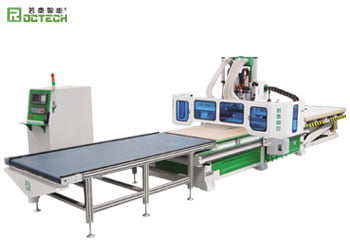
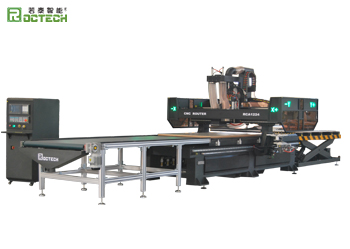
The data reveal that mechanical wear and backlash account for nearly one-third of all depth inconsistency cases. This finding underscores the importance of regular maintenance on ball screws and guide rails—components that Roctech sources from Taiwan HIWIN and PMI, known for their precision and durability. In Roctech’s RCA series automatic loading and unloading nesting centers, for instance, the use of double-nut preloaded ball screws on the Z-axis reduces backlash to less than 0.02 mm, significantly mitigating depth drift over extended production runs.
Technical Countermeasures and Best Practices
Mechanical Inspection and Adjustment
When diagnosing depth inconsistency, the first step should always be a mechanical check. Operators should perform a dial indicator test on the Z-axis at multiple positions along the travel range. A deviation exceeding 0.05 mm indicates backlash or wear. For machines equipped with rack-and-pinion drives on X/Y axes—common in large-format routers—backlash in the Z-axis ball screw remains the predominant culprit.
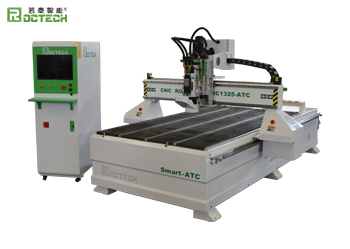
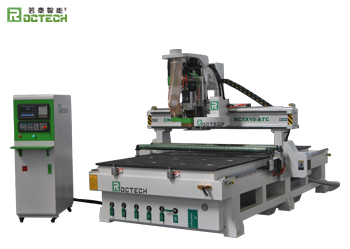
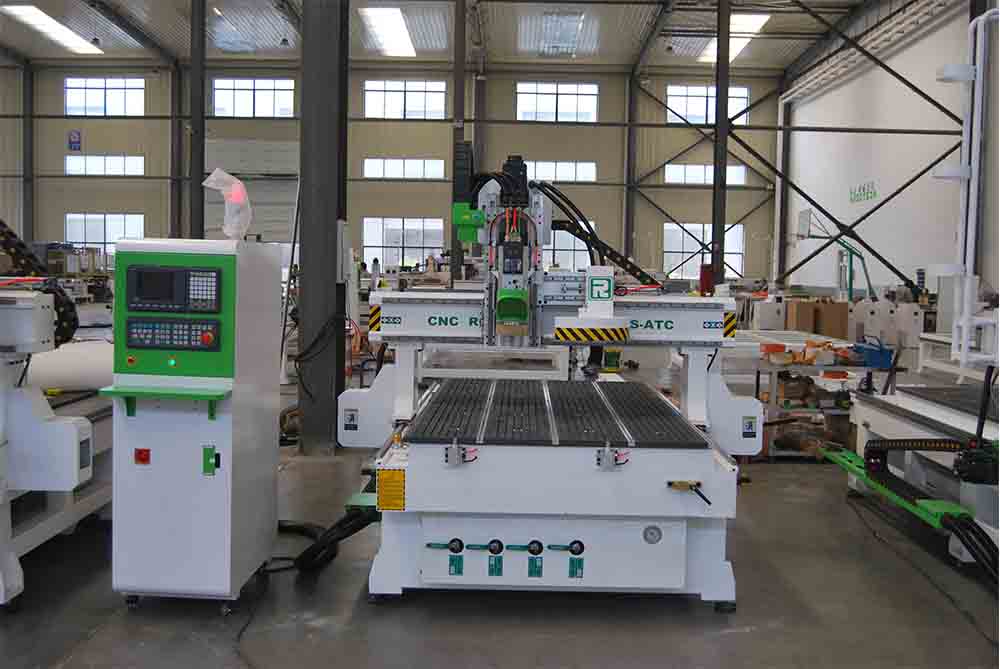
Roctech’s ATC series, such as the RC1325S-ATC, employs a heavy-duty welded steel bed and preloaded linear guides, which maintain rigidity even under continuous high-speed operation. The company recommends a weekly lubrication schedule using HIWIN-approved grease, and a monthly backlash compensation check via the Syntec control system’s built-in measurement routine.
Tool Holding and Runout Control
Tool runout is the second most common cause. Even a 0.03 mm runout at the collet can produce visible depth variation on softwoods and acrylics. Using a precision collet (ER32 or ER40) and a tool presetter with 0.01 mm resolution is essential. Roctech’s Smart-ATC system includes an automatic tool measurement cycle that records each tool’s actual length and diameter before every job, compensating for thermal expansion and wear.
Material Considerations
Wood and stone are inherently heterogeneous. For solid wood, grain direction and density variations (e.g., earlywood vs. latewood in softwoods
Looking for more information about our CNC machines and services? Contact us today.
Contact
Previous:Precision Machining of Ash Wood: CNC Router Performance and Market Integration
Next:Title: Demystifying CNC Programming: Accessibility, Learning Curve, and Industry Realities