
The Next Frontier in CNC Routing: Automation, Accuracy, and Material Versatility
About Us / Author:ROCTECH Engineer Team / Published: Jul 21 , 2026 / Last Updated: Jul 21 , 2026
Abstract
CNC routers have evolved from niche engraving tools into core production platforms across woodworking, signage, mold-making, and light-metal fabrication. This article examines current market dynamics, the technological convergence driving machine specifications upward, and how manufacturers like Roctech are responding with integrated automation and multi-process capabilities. A data-driven analysis of regional adoption trends and model parameters provides a framework for equipment selection in 2025.
---
Industry Background: From Dedicated Machines to Flexible Platforms
The global CNC router market has experienced steady growth, projected to exceed USD 6.2 billion by 2028 at a compound annual growth rate (CAGR) of approximately 7.3%. This expansion is fueled by the rise of customized furniture production, the shift toward just-in-time manufacturing, and the increasing adoption of CNC technology by small and medium enterprises in emerging economies.
Woodworking remains the dominant application segment, accounting for over 55% of CNC router installations worldwide. However, the same platform technology—gantry structure, servo-driven axes, spindle tooling—is increasingly deployed for non-wood materials: acrylic, aluminum composite panels, engineering plastics, and even soft stone. The modern CNC router is no longer a single-purpose machine; it is a configurable machining center.
Table 1: CNC Router Market Segmentation by Application and Region (Estimated 2024–2025)
| Application Segment | Market Share (%) | Primary Regions | Typical Machine Configuration |
|---------------------|------------------|-----------------|------------------------------|
| Woodworking (furniture, cabinetry) | 55–60 | Asia-Pacific, North America, Europe | Nesting center with auto loading/unloading |
| Advertising & signage | 15–18 | Global | Standard 1325 ATC, laser hybrid |
| Mold & pattern making | 8–10 | Europe, China, India | Four-axis or five-axis simultaneous |
| Light metal & composite | 6–8 | North America, Western Europe | Heavy-duty gantry, high-speed spindle |
| Stone & ceramic | 3–5 | Italy, China, Middle East | Water-cooled spindle, rigid bed |
| Other (education, crafts) | 5–8 | Global | Small-format 6090/1212 |
Source: Compiled from industry estimates, trade association data, and Roctech internal market intelligence.
Interpretation of Table 1
Woodworking dominates because the panel furniture industry—particularly custom cabinetry and wardrobe production—demands high throughput, minimal labor, and near-zero material waste. The nesting center configuration, often equipped with automatic loading and unloading, has become the de facto standard for this segment. Advertising and signage remain the second-largest segment, driven by the need for rapid prototyping and short-run production of acrylic and PVC components. The mold segment, while smaller in volume, commands higher per-unit machine value due to the precision and multi-axis requirements.
---
Technology Convergence: What the Modern CNC Router Must Deliver
The gap between a basic engraving machine and a production-grade machining center has widened. Today’s CNC router must offer:
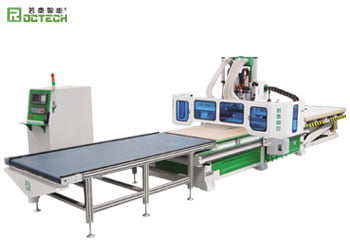
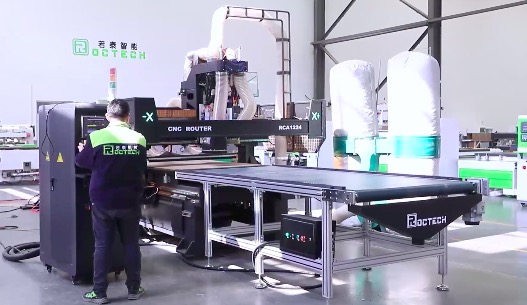
- Multi-process capability: Cutting, drilling, grooving, and edge profiling in a single setup. Machines like the Roctech RCA series nesting centers integrate row drill groups and automatic labeling systems, eliminating secondary operations.
- Automated material handling: Automatic loading and unloading systems reduce manual intervention. The Roctech Master series, for example, feeds raw panels directly from a stack, processes them through optimized nesting patterns, and unloads finished parts with QR code identification.
- High-speed, high-accuracy motion: Linear guides from HIWIN or THK, combined with Yaskawa servo drives and rack-and-pinion transmission, enable rapid traverse speeds exceeding 45,000 mm/min while maintaining positioning accuracy within ±0.03 mm per 300 mm.
- Tool management: Carousel or linear tool magazines with capacities from 8 to 24 tools allow automatic tool changes, enabling complex operations without operator intervention.
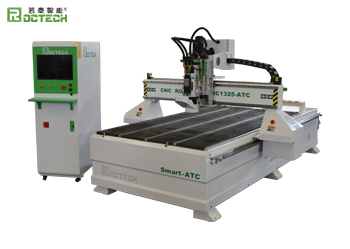
Roctech’s RC1325S-ATC exemplifies this convergence: a 1300 × 2500 mm working area, 9 kW spindle, 8-tool carousel, and vacuum adsorption table. It handles wood, MDF, acrylic, and aluminum composite panels with equal reliability. The company’s positioning in the mid-to-high end of the market—using imported components combined with localized assembly—strikes a balance between cost and performance that appeals to both domestic Chinese buyers and export customers in over 100 countries.
---
Regional Dynamics and the Push for Intelligence
Asia-Pacific, led by China, accounts for nearly 40% of global CNC router consumption. The domestic furniture industry’s shift from mass production to mass customization has driven demand for nesting centers and automatic tool chang
Looking for more information about our CNC machines and services? Contact us today.
Contact