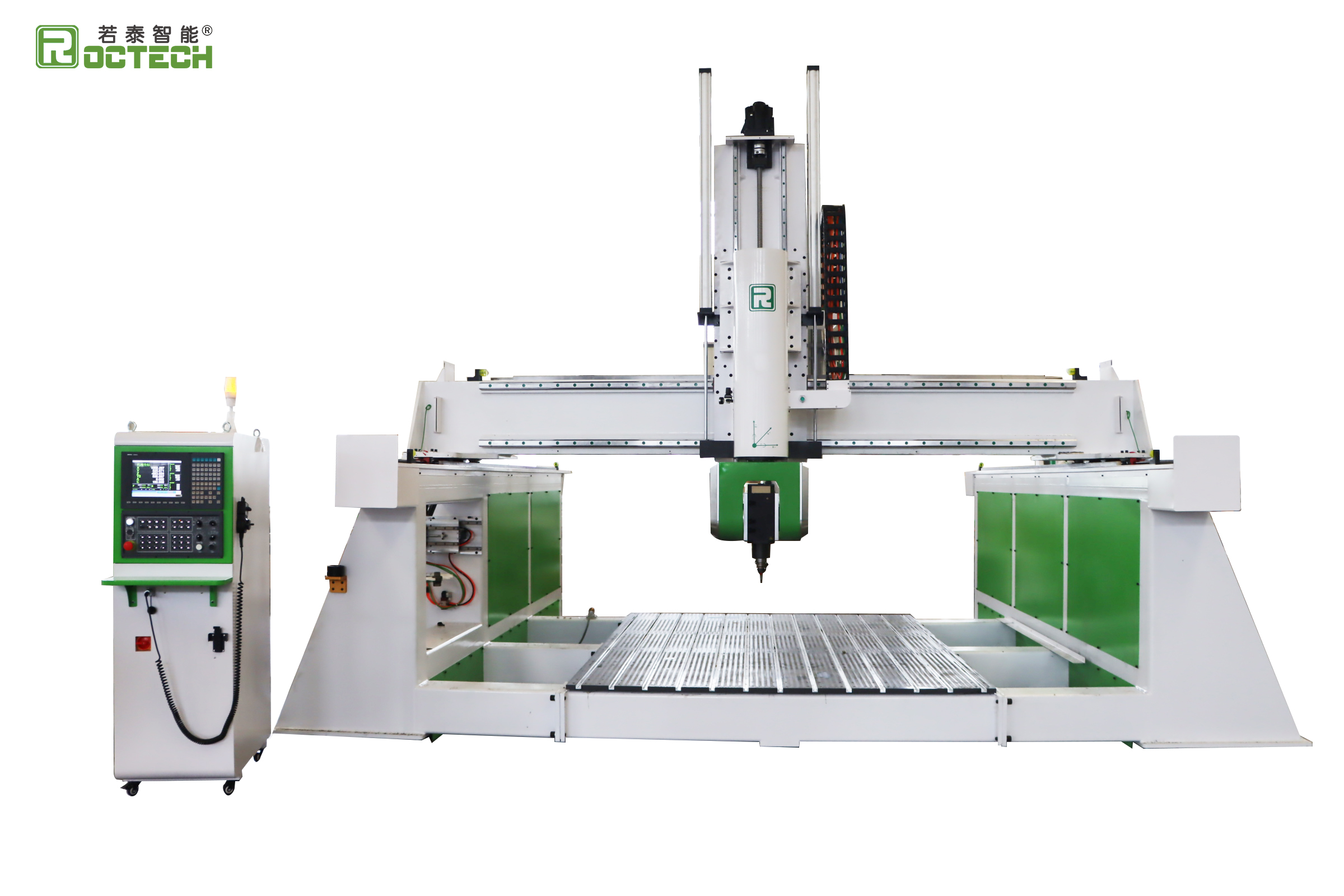

RCF2040: Scaling Five-Axis Precision for Heavy-Duty Mold and Furniture Applications
About Us / Author:ROCTECH Engineer Team / Published: Aug 01 , 2026 / Last Updated: Aug 01 , 2026
---
Abstract
The transition from conventional three-axis machining to five-axis simultaneous processing represents a significant leap in manufacturing capability, particularly for industries demanding complex geometries and reduced setup times. Among the emerging solutions in this space, the heavy-duty five-axis machining center has become a critical asset for automotive mold makers, shipbuilders, and high-end solid wood furniture manufacturers. This article examines the technical architecture, application scope, and market positioning of the heavy-duty segment, using the RCF2040 as a reference model to illustrate broader industry trends toward rigidity, automation, and multi-sided processing.
---
Industry Background and Market Dynamics
The global CNC machinery market has witnessed a steady shift toward multi-axis platforms over the past decade. According to industry reports, the five-axis machining center segment is projected to grow at a compound annual growth rate of approximately 6.8% between 2024 and 2030, driven by demand from aerospace, automotive, and custom manufacturing sectors. In the woodworking and mold industries specifically, the need to process large, contoured workpieces in a single clamping operation has accelerated adoption of heavy-duty five-axis systems.
The following table summarizes key parameters across representative heavy-duty five-axis models commonly deployed in mold and furniture applications:
| Parameter | RCF1325 | RCF1838 | RCF2040 | RCF2560 |
|-----------|---------|---------|---------|---------|
| Worktable Size (mm) | 1300×2500 | 1800×3800 | 2000×4000 | 2500×6000 |
| Spindle Power (kW) | 10 | 12 | 15 | 18 |
| Spindle Speed (RPM) | 0–24,000 | 0–24,000 | 0–20,000 | 0–20,000 |
| A-axis Swing Angle | ±110° | ±110° | ±110° | ±120° |
| C-axis Rotation | 360° continuous | 360° continuous | 360° continuous | 360° continuous |
| Positioning Accuracy (mm) | ±0.05 | ±0.05 | ±0.05 | ±0.05 |
| Repeat Positioning Accuracy (mm) | ±0.03 | ±0.03 | ±0.03 | ±0.03 |
| Max Rapid Traverse (mm/min) | 30,000 | 28,000 | 25,000 | 22,000 |
| Machine Weight (kg) | 8,500 | 12,000 | 15,500 | 22,000 |
The data reveals a deliberate trade-off between work envelope and dynamic performance. As table dimensions expand—from 3.25 m² on the RCF1325 to 15 m² on the RCF2560—rapid traverse speeds decline, reflecting the increased inertia and structural mass required to maintain rigidity. For heavy-duty applications such as large thermoforming molds or ship hull patterns, the RCF2040 offers a balanced configuration: a 2000×4000 mm worktable accommodates substantial workpieces while retaining a practical 25,000 mm/min rapid traverse. This positions the RCF2040 as a versatile workhorse for manufacturers needing both scale and reasonable cycle times.
---
Technical Architecture and Application Considerations
A five-axis simultaneous machining center fundamentally alters the machining strategy for complex parts. The combination of three linear axes (X, Y, Z) with two rotary axes (A and C) enables the tool to approach the workpiece from virtually any orientation. For mold makers, this means draft angles, undercuts, and deep cavities can be machined without repositioning the part, eliminating cumulative clamping errors and reducing total processing time by 30–50% compared to multi-setup three-axis workflows.
The RCF2040 exemplifies this architecture with an integral welded bed structure, designed to dampen vibration during heavy cuts. Its spindle—rated at 15 kW with a maximum speed of 20,000 RPM—delivers sufficient torque for roughing operations in aluminum, pre-hardened steel, and engineered wood composites. The A-axis, with a ±110° swing, provides the angular flexibility necessary for machining contoured surfaces such as automotive interior trim molds or ergonomic solid wood chair frames. Meanwhile, the C-axis’s continuous 360° rotation allows for helical interpolation and complex spiral tool paths without manual intervention.
One practical advantage observed in production environments is the reduction of hand-finishing work. Because the five-axis system maintains a consistent tool-to-surface relationship, scallop height remains uniform, and surface finishes often meet or exceed Ra 3.2 µm directly off the machine. For furniture manufacturers producing curved panels or sculpted armrests, this minimizes the need for extensive sanding, thereby shortening lead times
Looking for more information about our CNC machines and services? Contact us today.
Contact
Previous:Title: Precision Engraving of Maple: Evaluating CNC Solutions for Hardwood Applications
Next:Three-Axis Machining Centers: The Backbone of Modern Woodworking and Stone Fabrication