
Lecong Furniture Fair 2024: CNC Automation Reshapes the Pearl River Delta Manufacturing Hub
About Us / Author:ROCTECH Engineer Team / Published: Aug 06 , 2026 / Last Updated: Aug 06 , 2026
The Lecong Furniture Fair, held biannually in Foshan’s Shunde district, has long served as a barometer for China’s sprawling furniture manufacturing sector. What began in 2001 as a regional exhibition for upholstery and traditional hardwood pieces has evolved into a 100,000-square-meter showcase of production technology, raw materials, and finished goods. While the fair’s public galleries attract interior designers and procurement agents, the more consequential action occurs in the machinery halls, where factory owners from Guangdong, Sichuan, and increasingly Southeast Asia gather to evaluate capital equipment purchases. This year, the dominant conversation was not about veneer finishes or joinery techniques, but about CNC automation—specifically, how nesting centers, six-sided drills, and edge banding lines can compress lead times on custom cabinetry from three weeks to four days.
The economic logic driving this shift is visible in regional production statistics. According to the Guangdong Furniture Association, the province’s custom furniture segment grew at an annual rate of 18.7% between 2019 and 2023, while standard flat-pack furniture grew at only 4.2%. This divergence is squeezing margins for shops still relying on manual saws and conventional drill presses. A typical mid-sized cabinet workshop in Lecong—employing 15 to 20 workers—faces labor costs that have risen 32% since 2020, alongside client demands for increasingly complex hardware integration. The response, as demonstrated across the fair’s machinery pavilions, is a rapid migration toward panel-processing machinery that consolidates cutting, drilling, grooving, and labeling into a single work cell.
| Equipment Category | 2019 Import Penetration (CRD Region) | 2024 Unit Price Range (USD) | Typical Cycle Time per Panel | Labor Reduction vs. Conventional Line |
|---|---|---|---|---|
| Manual panel saw + drill line | 22% | 8,000 – 15,000 | 18–25 min | Baseline |
| CNC nesting center (3-axis) | 41% | 25,000 – 60,000 | 6–9 min | 40–55% |
| ATC nesting center with row drill | 33% | 55,000 – 110,000 | 4–6 min | 60–70% |
| Six-sided CNC drill (post-nesting) | 28% | 70,000 – 120,000 | 2–3 min | 50–65% |
| Fully integrated line (nesting + drill + edge band) | 12% | 180,000 – 350,000 | 3–4 min (whole panel) | 75–85% |
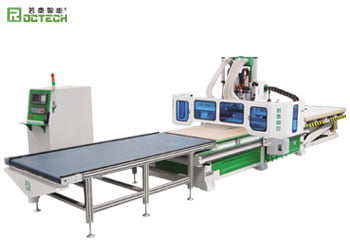
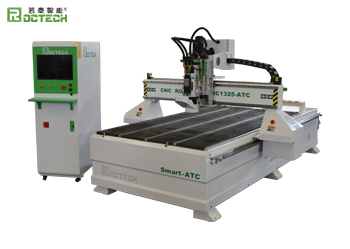
The table above, compiled from exhibitor specification sheets and customs data for the Pearl River Delta (PRD) region, reveals a market bifurcating between three-axis entry machines and fully integrated production cells. The middle ground—standalone nesting centers without automatic loading or tool changers—is losing appeal. Factory owners interviewed at the Roctech booth consistently cited two purchasing justifications: first, the ability to run unattended during night shifts, which requires automatic loading/unloading and tool magazine capacity; second, software compatibility with cabinet design platforms such as Haixun and 1010, allowing direct conversion from shop drawings to G-code without manual programming. Roctech's RCA1224 automatic loading and unloading nesting center, which pairs a 9.6 kW spindle with a double-layer vacuum table and a 12-position carousel tool magazine, exemplifies this trend. The machine’s Yaskawa servo drives and Syntec control system are now standard specifications on most mid-tier equipment, but Roctech’s integration of an optional labeling head and row drill group distinguishes it from less complete offerings.
Beyond the machinery itself, the fair revealed a subtler shift in how Chinese manufacturers approach quality assurance. Five years ago, a woodworking shop in Lecong might have accepted positioning tolerances of ±0.1 mm per panel. Today, with the rise of whole-house customization and the need for cabinet boxes to align perfectly across multiple production batches, repeatability of ±0.03 mm is becoming the de facto requirement. This is achievable with ball-screw-driven Z axes and rack-and-pinion X/Y systems, provided the machine bed is sufficiently rigid. Roctech’s five-axis machining centers, such as the RCF1325 with an Italian OSAI control system and a ±110° swiveling A-axis, are marketed primarily for mold and solid-wood applications, yet their presence at the fair signals that even traditional carving shops are exploring multi-axis simultaneous machining. The RCF1325, weighing 8.5 tons with a 10 kW spindle, is an over-engine
Looking for more information about our CNC machines and services? Contact us today.
Contact
Previous:CNC Metal Drilling Machines: Precision, Automation, and the Evolving Landscape of Modern Fabrication