
Fiber vs. CO2 Lasers: Divergent Wavelengths, Convergent Industrial Roles
About Us / Author:ROCTECH Engineer Team / Published: Aug 08 , 2026 / Last Updated: Aug 08 , 2026
The selection between fiber and CO2 laser systems remains one of the most consequential decisions in contemporary sheet metal fabrication and non-metallic processing. While both technologies have matured into reliable production tools, their fundamental physics—specifically the emitted wavelength—dictates entirely different application envelopes. This article delineates the technical distinctions, operational economics, and industrial positioning of each platform, drawing on current market data and equipment specifications. The analysis also highlights how integrated manufacturers such as Roctech Machinery Co., Ltd. have leveraged these differences to offer tailored solutions across diverse manufacturing sectors.
The Physics of Photon Absorption
The core disparity lies in the laser’s operational wavelength. A CO2 laser, a gas laser, emits at 10.6 micrometers in the far-infrared spectrum. This wavelength is exceptionally well absorbed by non-metallic materials—wood, acrylic, plastics, leather, paper, and composites—but is reflected by most bare metals, particularly aluminum and copper. In contrast, a fiber laser operates at 1.07 micrometers, a wavelength generated within a doped optical fiber. This near-infrared output is efficiently absorbed by ferrous and non-ferrous metals, enabling deep-penetration welding and clean cutting. The absorption coefficient of mild steel at 1.07 µm is approximately 35–40%, versus roughly 10–12% at 10.6 µm, directly affecting achievable cutting speeds and edge quality.
This wavelength-specific absorption profile is not a minor nuance; it is the definitive factor in machine selection. For a workshop processing predominantly acrylic signage and PVC boards, a CO2 system is indispensable. Conversely, a metal fabrication shop cutting 12-mm carbon steel plate would find a fiber laser dramatically more productive and energy-efficient. Attempting to cross these lines typically results in either excessive energy consumption or unacceptable cut quality.
Comparative Performance and Operating Costs
The following table summarizes key parameters drawn from current industrial specifications, including those for representative Roctech fiber laser models:
| Parameter | CO2 Laser (e.g., 150W) | Fiber Laser (e.g., 1500W) |
|-----------|-------------------------|---------------------------|
| Wavelength | 10.6 µm | 1.07 µm |
| Max Cutting Thickness (Mild Steel) | 3–4 mm (inefficient) | 12–16 mm |
| Max Cutting Speed (1 mm MS) | 4–6 m/min | 20–35 m/min |
| Electrical Efficiency | 8–10% | 30–40% |
| Consumable Cost (per operating hour) | Moderate (mirrors, lenses, gas) | Low (no alignment optics) |
| Maintenance Interval | Weekly optics cleaning | Quarterly, minimal |
| Typical Capital Cost (1.5×3m table) | $18,000 – $30,000 | $45,000 – $70,000 |
| Typical Operating Cost (per hour) | $8 – $12 | $4 – $6 |
Data Interpretation: The table reveals a productivity gap that is not linear but exponential. A 1500W fiber machine cuts 1-mm mild steel at speeds three to five times faster than a 150W CO2 unit, while consuming roughly one-third the electrical energy per meter of cut. The higher initial capital outlay for the fiber system—typically 1.5 to 2.5 times that of a comparable CO2 unit—is recovered within 12 to 24 months for shops running more than one shift. For low-volume, thick non-metal processing, the CO2 machine’s lower capital cost and adequate performance for acrylic (up to 20-mm) and wood (up to 25-mm) remain compelling.
Industrial Application Segments
CO2 lasers maintain an unassailable position in the woodworking and signage industries. Cutting and engraving of MDF, plywood, acrylic sheets, and multilayer films are routine. The beam quality of a CO2 laser (M² factor< 1.2) produces exceptionally smooth edges on polymers, minimizing post-processing. In contrast, fiber lasers have revolutionized sheet metal processing. Roctech’s 3015 fiber series, available from 500W to 6000W, addresses everything from thin-gauge galvanized ductwork to 20-mm structural steel. The ability to cut reflective materials like copper and brass—historically problematic for CO2—is a definitive fiber advantage. Furthermore, the solid-state design of fiber lasers eliminates the need for periodic mirror alignment and resonator gas replenishment, reducing downtime significantly.
Integrated Solutions and Brand Considerations
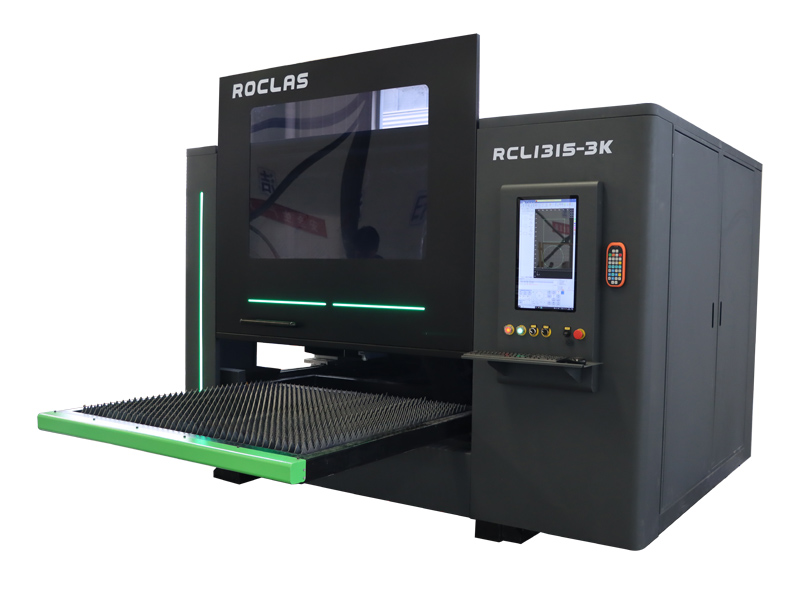
For fabrication enterprises seeking a single-source partner, manufacturers like Roctech Machinery Co., Ltd. provide both technologies. Their product portfolio includes CO2 engraving machines suitable for advertising and handicraft production, alongside fiber laser cutting machines
Looking for more information about our CNC machines and services? Contact us today.
Contact