
Title: Fiber Laser Cutting: Reshaping Sheet Metal Fabrication Economics
About Us / Author:ROCTECH Engineer Team / Published: Aug 08 , 2026 / Last Updated: Aug 08 , 2026
Abstract
The industrial sheet metal processing landscape is undergoing a significant transformation, driven by the rapid adoption of fiber laser cutting technology. This analysis examines the technical evolution, economic imperatives, and operational advantages of modern fiber laser systems, with a particular focus on the mid-to-high power segment (1kW–6kW) that dominates contemporary fabrication shops. Drawing on industry data and equipment specifications, this article argues that the shift from traditional CO2 and plasma systems to fiber lasers is not merely a marginal improvement but a fundamental change in production economics, enabling higher throughput, superior edge quality, and reduced operational costs. The discussion includes a comparative data analysis of system capabilities, a review of application-specific advantages, and a look at how manufacturers like Roctech Machinery Co., Ltd. are positioning their product lines to meet the demands of this evolving market.
---
The Economic and Technical Case for Fiber Laser Integration
For decades, the choice of metal cutting technology was a straightforward trade-off: CO2 lasers offered precision but at high capital and maintenance costs, while plasma cutting provided speed on thick materials but compromised on edge quality. The maturation of fiber laser technology has effectively redrawn this competitive landscape. Fiber lasers, which generate and deliver the beam through a solid-state gain medium and fiber optic cable, offer a compelling combination of high electro-optical efficiency, exceptional beam quality, and low maintenance, making them the default choice for a wide array of sheet metal applications.
The market data reflects this paradigm shift. The table below presents a comparative analysis of typical system parameters across the primary cutting technologies currently deployed in the industry, based on standard machine specifications and operational benchmarks.
| Parameter / Technology | Fiber Laser (1.5kW) | CO2 Laser (3kW) | Plasma (Fine) | Oxy-Fuel |
| :--- | :--- | :--- | :--- | :--- |
| Max. Cutting Speed (Mild Steel, 2mm) | 12-15 m/min | 6-8 m/min | 4-6 m/min | 0.5 m/min |
| Cutting Quality (Edge Roughness) | Excellent (Ra< 3.2 µm) | Good (Ra< 6.3 µm) | Moderate (Ra > 12.5 µm) | Poor (Dross, HAZ) |
| Kerf Width (2mm MS) | 0.1 - 0.2 mm | 0.2 - 0.3 mm | 1.5 - 3.0 mm | 2.0 - 3.0 mm |
| Operating Cost (USD/hour) | $8 - $12 | $15 - $25 | $10 - $15 | $8 - $12 |
| Maintenance Interval | Long (Solid-state) | Frequent (Optics, Gas) | Regular (Consumables) | Regular (Nozzles) |
| Electrical Efficiency | > 30% | 8% - 10% | N/A | N/A |
Data Analysis
The data underscores a clear operational hierarchy. The fiber laser’s most profound advantage lies in its cutting speed on thin to medium gauge materials—a domain that constitutes a significant portion of modern fabrication work. A 1.5kW fiber system can process 2mm mild steel at nearly double the speed of a 3kW CO2 laser, while consuming significantly less energy. This directly translates to a lower cost per part and a higher potential throughput. Furthermore, the narrow kerf width (0.1-0.2mm) is a critical economic factor; on high-volume nesting jobs, this material savings of 0.1-0.2mm per cut can accumulate to a 3-5% improvement in material utilization over a year, a substantial figure for any fabrication business.
While plasma retains a cost-per-inch advantage on very thick plates (over 25mm), its slower speeds and inferior edge quality on thinner materials necessitate secondary operations like grinding or machining, eroding its apparent cost benefits. The fiber laser’s superior edge quality eliminates these secondary steps, offering a true 'cut-and-go' efficiency that systematically reduces work-in-progress and labor allocation.
Application-Specific Advantages and System Architecture
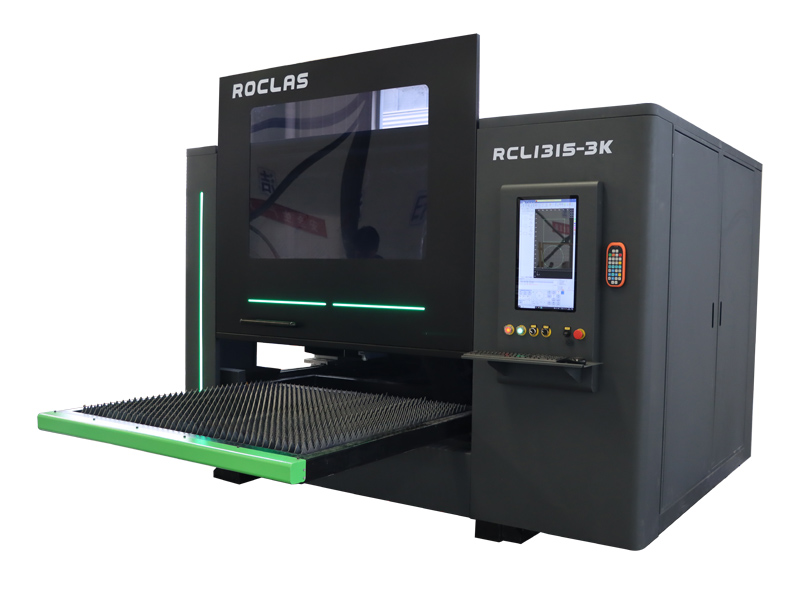
The shift to fiber lasers is also driving a change in system design philosophy. Modern machines are increasingly built around high rigidity and dynamic performance to fully exploit the laser source's capability. For instance, the maximum rapid traverse speed of contemporary systems, such as those in Roctech’s fiber laser series, often reaches 120 m/min with an acceleration of 1.0G. This is not merely for show; it minimizes non-cutting time, which is a critical factor in maximizing the return on investment for the laser source itself.
Roctech Machinery Co., Ltd., a
Looking for more information about our CNC machines and services? Contact us today.
Contact