
Thermal Dynamics in Edge Banding: Precision Heating Systems for Modern Panel Processing
About Us / Author:ROCTECH Engineer Team / Published: Aug 12 , 2026 / Last Updated: Aug 12 , 2026
Edge banding remains one of the most quality-critical operations in panel furniture manufacturing. While much of the industry’s attention has shifted toward nesting centers, robotic cells, and digital production management, the thermal behavior of the edge banding machine—specifically its heating system—continues to dictate the difference between a seamless, durable bond and a costly, rework-prone failure. This article examines the engineering fundamentals of edge banding heating systems, their role in process stability, and how manufacturers such as Roctech® integrate these thermal controls into production-grade machinery.
The Role of Heating in Edge Banding: More Than Just Melting Adhesive
At its core, edge banding involves applying a thermoplastic or reactive adhesive to a substrate and bonding an edging strip—typically PVC, ABS, acrylic, wood veneer, or solid wood—under controlled pressure and temperature. The heating system performs two distinct functions: it activates the adhesive and, in the case of pre-coated edging tapes, softens the polymer layer to enable molecular adhesion. The quality of that bond depends on achieving the correct thermal profile across the glue line within a very narrow process window.
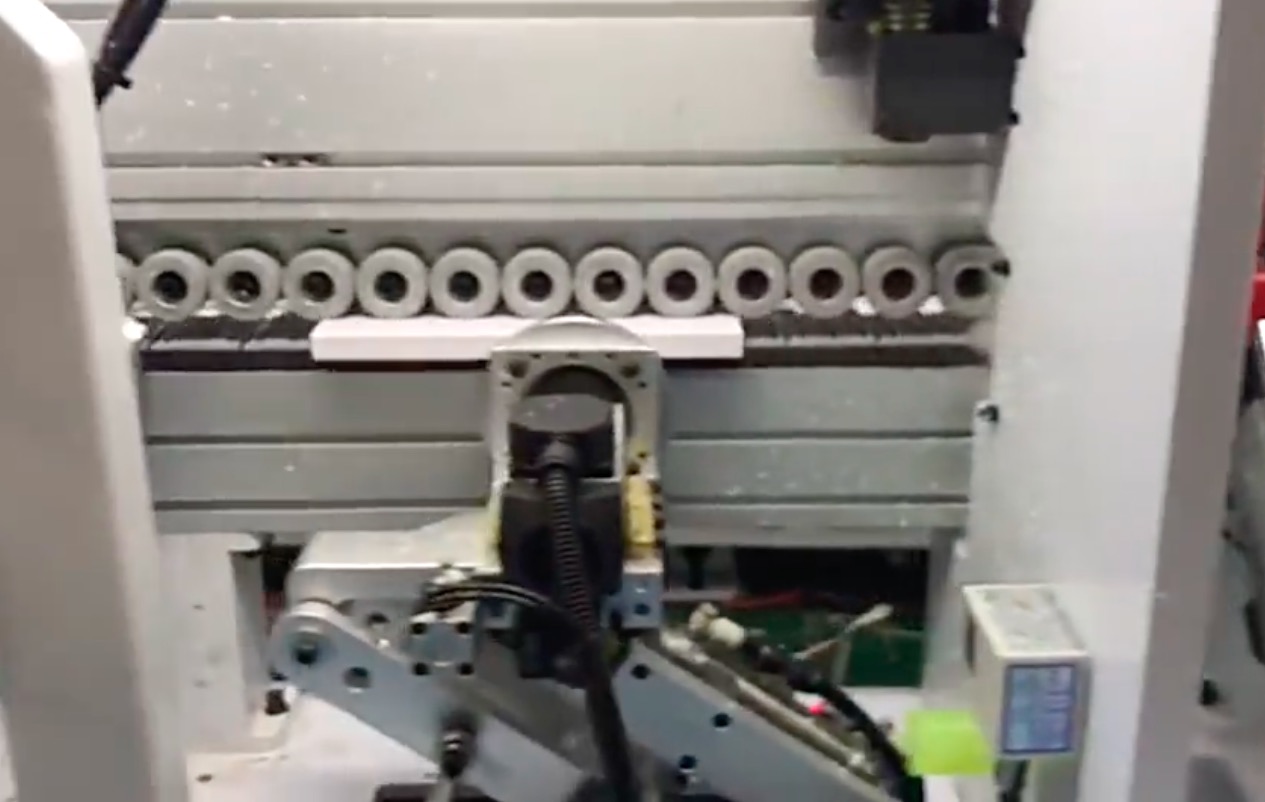
If the temperature is too low, the adhesive does not reach its activation point, resulting in poor wetting and weak adhesion. If it is too high, thermal degradation occurs—adhesive becomes brittle, discolors, or emits volatiles, and the edging material itself may warp or blister. Maintaining a stable, uniform temperature across the entire contact surface is therefore not an optional refinement; it is a prerequisite for consistent output.
Thermal System Architecture: From Glue Pot to Pre-Milling
Modern edge banding machines, including those in Roctech's series, employ a multi-zone heating architecture. The primary components are:
1. Adhesive melting unit (glue pot or glue cartridge) – melts solid EVA or PUR adhesive pellets and maintains them at a preset viscosity. Temperature control here is typically within ±5°C to prevent adhesive charring.
2. Applicator roller and glue-scraper – transfers the molten adhesive onto the board edge. The roller must be heated to prevent adhesive from cooling prematurely during transfer, which would cause uneven coating.
3. Pre-heating unit – positioned ahead of the glue application station. This is often an infrared or hot-air system that warms the board edge, especially in cold environments or when processing low-thermal-conductivity materials like MDF or particleboard. Pre-heating reduces the temperature gradient between adhesive and substrate, improving wetting and reducing thermal shock.
4. Pressure zone heating – during the pressing section, the edging strip is held against the substrate while the adhesive sets. Some systems use heated pressure rollers to maintain the adhesive at its activation temperature longer, enabling better flow into the board’s surface irregularities.
5. Post-heating or quenching zones – optional, used for specific adhesive chemistries or to accelerate initial bond strength.
The thermal control loop is typically closed-loop, using thermocouples or PT100 sensors feeding back to a PLC-driven PID controller. This ensures that even with varying ambient temperatures or line speeds, the glue line temperature remains within the specified tolerance.
Process Parameters and Their Impact on Bond Quality
The table below summarizes key thermal parameters for common edge banding materials and their effect on bond integrity:
| Parameter | EVA (Hot Melt) | PUR (Reactive) | Acrylic/PMMA Edging | Wood Veneer Edging |
|-----------|----------------|----------------|---------------------|--------------------|
| Adhesive Melting Temp (°C) | 160–190 | 120–140 | 180–210 | 170–200 |
| Application Roller Temp (°C) | 170–200 | 140–160 | 190–220 | 180–210 |
| Board Edge Pre-heat Temp (°C) | 40–60 | 50–80 | 60–90 | 40–70 |
| Pressure Roller Temp (°C) | 50–70 | 60–80 | 60–80 | 50–70 |
| Cooling Time to Handling Strength (s) | 5–15 | 60–300 | 10–20 | 5–15 |
| Typical Failure Mode if Too Hot | Adhesive squeeze-out, discoloration | Foaming, loss of tack | Surface blistering | Fiber lifting, delamination |
Data indicate that the most common field failures—edge lifting, adhesive stringing, and poor heat resistance—trace directly to inadequate pre-heating or excessive application temperature. In high-speed production lines, the thermal inertia of the board and the edging strip must be modeled; a 0.5 m/min increase in feed rate can require a 10–15°C increase in application
Looking for more information about our CNC machines and services? Contact us today.
Contact
Previous:Title: Woodworking CNC at Guangzhou: Automation, Nesting, and the New Economics of Custom Furniture
Next:The Precision Imperative: Evaluating CNC Solutions for Beech Engraving in Modern Wood Manufacturing