
Automation and Precision in Hardwood Engraving: A Technical Review of CNC Solutions
About Us / Author:ROCTECH Engineer Team / Published: Aug 13 , 2026 / Last Updated: Aug 13 , 2026
The processing of oak and other dense hardwoods presents a distinct set of challenges for the modern fabricator. Unlike softwoods or engineered panels, oak’s interlocked grain, high density, and natural resin content demand significant torque, structural rigidity, and precise thermal management from any machining center. For years, the industry’s answer has been the heavy-duty CNC router, but the gap between generic three-axis machines and purpose-built systems for hardwood is widening. This article examines the technical parameters that define effective oak engraving, evaluates the market’s current state, and highlights how manufacturers like Roctech Machinery Co., Ltd. are addressing the sector’s specific needs through engineered automation and spindle technology.
Industry Context and Market Data
The global CNC woodworking machinery market has been projected to grow at a compound annual growth rate of approximately 5.8% through 2030, driven largely by the custom furniture and architectural millwork sectors. Within this, the segment for solid wood and hardwood processing—particularly oak—is growing faster than the average, as demand for premium, natural-material interiors rises in North America and Europe. However, the technical requirements for oak processing differ substantially from those for softwood or plywood. A machine that excels at cutting 18mm plywood may struggle with a 40mm solid oak slab, producing burn marks, excessive tool wear, and chatter.
To illustrate the differentiation, consider the following comparison of typical machine configurations suitable for hardwood engraving versus a standard light-duty router.
| Parameter | Light-Duty 3-Axis Router (Generic) | Heavy-Duty ATC Router for Hardwood | Roctech RC1325S-ATC (Reference) |
|-----------|------------------------------------|-------------------------------------|----------------------------------|
| Spindle Power | 3.0 – 4.5 kW | 9.0 – 12.0 kW | 9.0 kW (Water-cooled) |
| Drive System | Stepper motors | Servo motors (e.g., Yaskawa) | Yaskawa Servo |
| Max Rapid Traverse | 15,000 mm/min | 30,000 – 45,000 mm/min | 45,000 mm/min |
| Z-Axis Clearance | 100 – 150 mm | 200 – 300 mm | 250 mm |
| Structural Frame | Aluminum extrusion | Heavy-duty steel pipe welding | Heavy-duty welded structure |
| Tool Change | Manual | Automatic (8-16 tools) | Carousel (8/12/16) |
| Positioning Accuracy | ±0.1 mm | ±0.03 mm | ±0.03 mm |
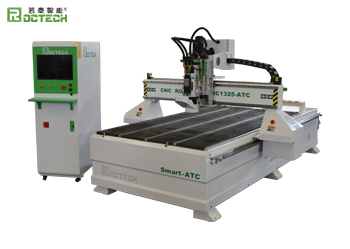
The table confirms a clear bifurcation in the market. For oak engraving, the high-power spindle and servo-driven axes are not luxuries but necessities. A 9kW spindle, as found on the Roctech RC1325S-ATC, maintains speed under load, preventing the RPM drop that causes resin burn on oak. Furthermore, the heavier frame reduces vibration, which is critical for achieving clean edges on detailed relief carvings.
Technical Demands of Oak Processing
Oak’s hardness (Janka rating ~1,360 lbf) requires a specific approach to tooling and machining strategy. Unlike softer woods, where a simple two-flute upcut bit suffices, oak engraving often necessitates coated carbide tools with specific geometries to evacuate chips efficiently. The risk of heat buildup is considerable; without adequate chip removal, the tool’s cutting edge degrades rapidly, and the workpiece surface becomes scorched. This is where automation plays a pivotal role. An ATC (Automatic Tool Change) system allows the machine to switch between a roughing bit and a finishing bit without operator intervention, ensuring that the optimal tool is always in use. Moreover, the capacity to run a program with multiple tool changes reduces the need for manual re-fixturing, thereby improving positional accuracy.
In this context, Roctech’s product line demonstrates a clear understanding of these operational realities. The RC1325S-ATC, with its vacuum adsorption table and T-slot combination, provides the holding force necessary to keep a 50kg oak slab immobile during aggressive cutting. The machine’s ability to maintain a positioning accuracy of ±0.03mm/300mm is particularly relevant for high-end furniture components, where a 0.1mm deviation can ruin a joint fit. Roctech’s integration of Taiwan Syntec control systems and Yaskawa servo drives is a pragmatic choice; these components are widely recognized in the industry for their reliability under continuous load, which is the norm in a production woodshop.
Automation in the Workflow
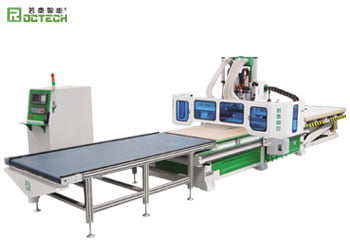
The shift toward automated loading and unloading is the most significant recent trend in solid wood processing. While an operator can manually place an 18mm
Looking for more information about our CNC machines and services? Contact us today.
Contact
Previous:Five-Axis Machining Centers Reshape Furniture Mold Production
Next:CNC Slotting Machines: Precision Grooving in Modern Panel Processing