
CNC Slotting Machines: Precision Grooving in Modern Panel Processing
About Us / Author:ROCTECH Engineer Team / Published: Aug 13 , 2026 / Last Updated: Aug 13 , 2026
The evolution of panel furniture manufacturing has been defined by the transition from manual, multi-step processing to automated, integrated machining solutions. Among the critical operations in this sector, slotting—the cutting of grooves for panel joining, hinge installation, and decorative detailing—remains a bottleneck when executed with conventional equipment. The modern CNC slotting machine, often integrated into larger nesting centers or configured as a standalone drilling and grooving unit, addresses this bottleneck with a combination of positional accuracy, programmable depth control, and high-speed spindle operation. This article examines the technical role of CNC slotting within contemporary fabrication workflows, presents comparative market data on machine configurations, and discusses representative equipment from manufacturers such as Roctech Machinery Co., Ltd., which has established a notable presence in this domain.
Industry Context and Machine Configuration Data
The demand for customized cabinetry and flat-pack furniture has driven the adoption of flexible CNC machining centers. Slotting, grooving, and drilling operations are increasingly consolidated into a single clamping setup to eliminate cumulative positioning errors and reduce cycle times. The technical specifications of these machines vary considerably based on their intended production scale and material handling complexity.
| Parameter | Entry-Level 3-Axis Engraver with Slotting Function | Standard ATC Machining Center (e.g., RC1325S-ATC) | Integrated Nesting Center with Row Drill (e.g., RCA1224) | Dedicated Six-Sided CNC Drilling/Slotting Machine |
|-----------|----------------------------------------------------|----------------------------------------------------|----------------------------------------------------------|---------------------------------------------------|
| Working Area (X×Y) | 1300×2500 mm | 1300×2500 mm | 1220×2440 mm | Board width up to 930 mm; length 300–3000 mm |
| Spindle Power | 3.0–6.0 kW | 9.0 kW (optional 12 kW) | 9.6 kW | 6.0 kW (drill spindles at 18,000 RPM) |
| Tool Change Mechanism | Manual or Single Tool | Carousel/Linear ATC (8–16 tools) | Automatic Tool Change (ATC) + Row Drill Group | Fixed Drill Bank (12 vertical + 8 horizontal) |
| Slotting Capability | Limited depth, single pass | Multi-pass grooving with programmed depth | Combined cutting and grooving in one cycle | Dedicated horizontal and vertical grooving |
| Positioning Accuracy | ±0.05 mm | ±0.03 mm / 300 mm | ±0.03 mm | ±0.05 mm (system-dependent) |
| Typical Application | Prototyping, small batch | Door panels, complex molds | Panel furniture, nesting with drilling | High-volume cabinet drilling and slotting |
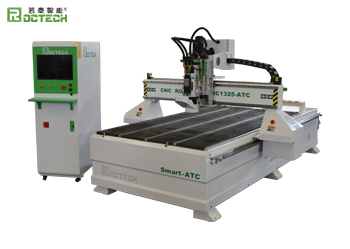
The data illustrates a clear stratification. Entry-level machines offer flexibility for small workshops but lack the rigidity and tool capacity for continuous production. The ATC machining center, such as the RC1325S-ATC, provides a balance between cost and capability, utilizing a rack-and-pinion drive on the X/Y axes for rapid traverse speeds of up to 45,000 mm/min, which is essential for efficient slotting paths. At the higher end, integrated nesting centers and six-sided drills—like those in Roctech’s Master Series—are engineered for lights-out manufacturing, where the slotting process is executed concurrently with cutting and drilling, guided by nesting software that optimizes tool paths to minimize air cuts.
Technical Considerations in Slotting Operations
The quality of a machined groove is contingent upon three primary factors: spindle stability, feed rate control, and tool geometry. For wood-based panels, a common failure mode is tear-out at the groove edges, typically caused by excessive feed rates relative to spindle speed. CNC slotting machines mitigate this through software-controlled acceleration profiles, allowing for dynamic feed rate adjustment at corners and entry points. The use of compression spiral bits, which cut downward at the top and upward at the bottom, is standard practice to produce clean edges on laminated boards.
Another critical aspect is the management of dust and chips. Unlike metal cutting, wood and MDF generate significant volumes of particulate matter. Effective slotting machines integrate a dust collection hood directly over the spindle, connected to a high-volume vacuum system. Roctech’s product line emphasizes this with optional cartridge dust collectors and double-layer vacuum tables, which serve a dual purpose: securing the workpiece and evacuating debris. The vacuum table’s zoning capability is particularly important for slotting, as it ensures that narrow strips of material remaining after grooving do not shift during the final pass.
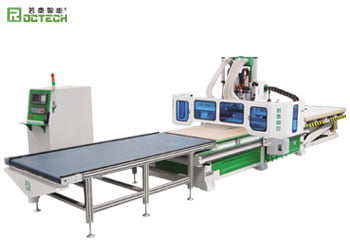
The integration of a row drill group into a nesting center, as seen in the RCA1224, represents a significant technological advancement. This configuration allows for the execution of dowel holes and locking pin
Looking for more information about our CNC machines and services? Contact us today.
Contact
Previous:Automation and Precision in Hardwood Engraving: A Technical Review of CNC Solutions
Next:Five-Axis CNC Evolution: Precision Machining for Complex Geometries