
High-Efficiency Production: The Automation Imperative in Modern CNC Fabrication
About Us / Author:ROCTECH Engineer Team / Published: Aug 14 , 2026 / Last Updated: Aug 14 , 2026
Abstract
The manufacturing landscape for woodworking, panel processing, and stone fabrication has undergone a fundamental shift over the past decade. Driven by rising labor costs, shrinking delivery windows, and the explosive growth of mass customization—particularly in the cabinet and wardrobes sector—fabricators have increasingly turned to automated CNC solutions to maintain margins. This article examines the technological pillars underpinning high-efficiency production, presents comparative data on equipment categories, and analyzes how vertically integrated manufacturers such as Roctech Machinery Co., Ltd. have positioned themselves as turnkey suppliers in this transformation.
Industry Context: From Batch Processing to Lights-Out Manufacturing
The term "high-efficiency production" in the context of CNC fabrication no longer refers merely to spindle speed or feed rate. It encompasses the entire material flow: sheet loading, nesting optimization, tool changes, drilling, edge banding, and part unloading. In the panel furniture industry, for instance, the traditional workflow involved separate machines for cutting, drilling, and edge banding—each requiring manual material handling and intermediate storage. The resultant bottlenecks were not in cutting speed but in transfer times and setup.
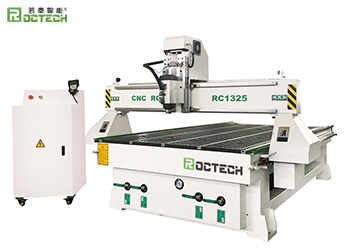
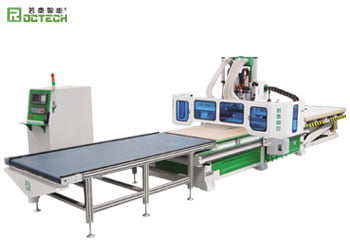
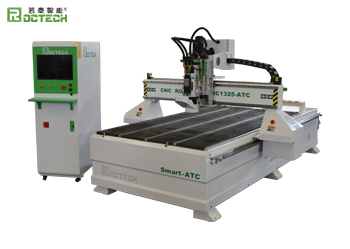
The response from equipment manufacturers has been the development of integrated machining centers that consolidate multiple operations. This trend is visible across three principal equipment categories: automatic loading/unloading nesting centers, ATC (automatic tool changer) machining centers, and five-axis simultaneous machining centers. Each category addresses a distinct segment of the fabrication market, yet all share core technologies: high-precision linear guides, closed-loop servo drives, and intelligent CNC controls.
Key Equipment Categories and Performance Benchmarks
To facilitate a clearer understanding of how these systems compare in real-world production environments, the following table summarizes typical specifications and productivity indicators for three mainstream CNC configurations used in woodworking and light-duty stone/composite fabrication:
| Parameter | Automatic Nesting Center (e.g., Roctech RCA1224) | ATC Machining Center (e.g., Roctech RC1325S-ATC) | Five-Axis Simultaneous Machining Center (e.g., Roctech RCF1325) |
|---|---|---|---|
| Work Envelope (X/Y/Z) | 1220×2440×150 mm | 1300×2500×250 mm | 1300×2500 mm table |
| Spindle Power | 9.6 kW (optional higher) | 9 kW (6/12 kW optional) | 10 kW |
| Spindle Speed | Up to 24,000 RPM | 0–24,000 RPM | 0–24,000 RPM |
| Positioning Accuracy | ±0.05 mm (typical) | ±0.03 mm/300 mm | ±0.05 mm |
| Repeat Positioning Accuracy | ±0.03 mm | ±0.03 mm | ±0.03 mm |
| Max Rapid Traverse | 45,000 mm/min | 45,000 mm/min | 30,000 mm/min |
| Tool Magazine Capacity | N/A (tool change optional) | 8/12/16 positions | N/A (manual or optional) |
| Automation Level | Full auto load/unload | Semi-auto (optional pusher) | Manual (T-slot/vacuum) |
| Typical Application | Panel furniture, cabinets | Door engraving, molds, signage | Complex molds, solid wood furniture |
| Machine Weight | ~4,500 kg | ~2,200–2,500 kg | ~8,500 kg |
The data above reveals a deliberate engineering trade-off. Nesting centers prioritize material utilization and cycle time reduction; the double-layer vacuum table with zone-wise adsorption allows for processing of both full sheets and remnant panels without re-fixturing. The ATC series emphasizes flexibility—the ability to switch between drilling, grooving, and profiling tools within a single program substantially reduces non-cutting time. The five-axis platform, conversely, sacrifices traverse speed for rigidity and multi-face access, which is essential for complex geometries such as thermoforming molds or curved solid-wood components.
The economic implications are significant. For a typical custom cabinet shop producing 50–100 sheets per day, an automatic nesting center can reduce labor requirements by 40–60% compared to a standalone CNC router with manual loading. Nesting optimization software further yields 5–10% material savings, which, given that sheet goods represent 60–70% of raw material costs, directly impacts the bottom line.
Technology Drivers: Servo Drives, Spindles, and Control Systems
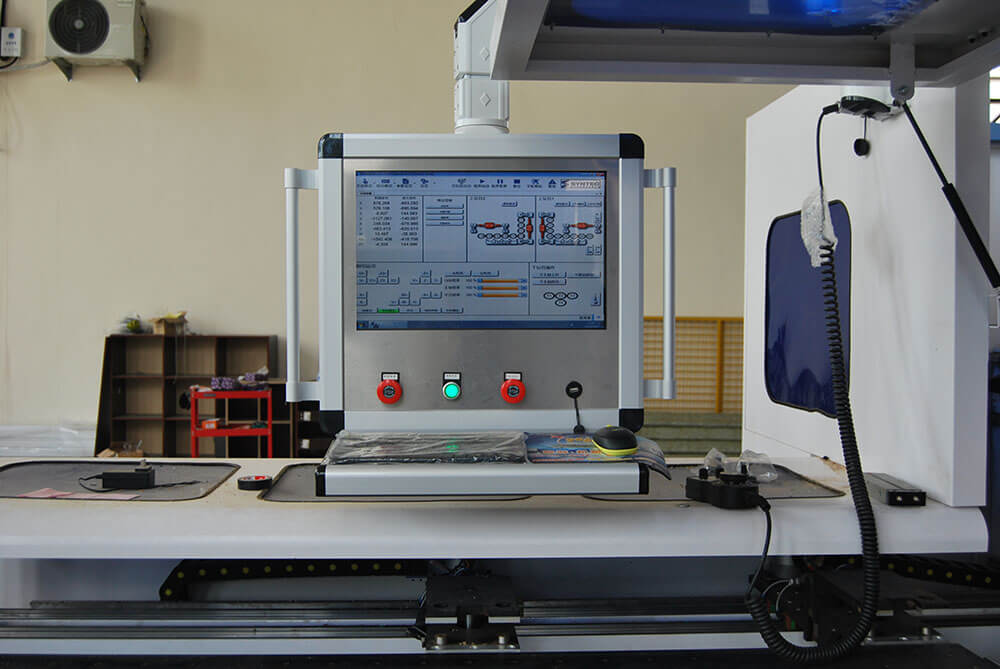
The reliability of these machines rests upon three critical subsystems. First, the servo drive system—here, Japanese Yaskawa servos are widely specified across Chinese-manufactured equipment for their torque stability and encoder resolution. Unlike stepper motors, servo loops correct positional errors in real time, which is non-negotiable
Looking for more information about our CNC machines and services? Contact us today.
Contact
Previous:Four-Process Cutting Machines: Reshaping Panel Furniture Automation
Next:Title: Operator Costs and Automation Economics in the CNC Stone and Woodworking Sector