
Title: Operator Costs and Automation Economics in the CNC Stone and Woodworking Sector
About Us / Author:ROCTECH Engineer Team / Published: Aug 14 , 2026 / Last Updated: Aug 14 , 2026
The question of operator wages in the CNC cutting machine segment is rarely answered with a single figure. Across the United States, the European Union, and China, the compensation for a skilled machine operator varies by more than a factor of three, depending on region, material type, and the level of automation integrated into the production cell. For a fabrication shop considering a new investment—whether a stone CNC bridge saw or a woodworking nesting center—the operator’s salary is not merely a line item on the P&L; it is a variable that directly influences the payback period of capital equipment. This article examines the cost structure of CNC operators, contrasts it against the productivity gains of automated systems, and discusses how suppliers such as Roctech Machinery Co., Ltd. are reshaping the labor equation through machine design.
The baseline data from industry surveys and job boards indicate that a competent CNC operator in the United States commands an annual salary between $45,000 and $62,000, inclusive of overtime and basic benefits. In Germany, the figure is slightly higher, often exceeding €50,000 due to formal apprenticeship requirements. In China’s manufacturing heartland, the same role attracts roughly ¥80,000 to ¥120,000 annually. However, the total cost of ownership for an employer extends beyond gross wages. Recruitment, training, and retention add an estimated 20% to 30% on top of base pay. More critically, the effective cost per production hour depends on how many machines one operator can manage. A conventional manual-load CNC router requires near-constant attention. An automated nesting center with a shuttle table, by contrast, allows a single operator to oversee two or even three machines simultaneously.
| Region | Average Annual Operator Cost (USD) | Machines Supervised per Operator | Effective Labor Cost per Machine-Hour (USD) |
|--------|-----------------------------------|-----------------------------------|---------------------------------------------|
| United States | 54,000 | 1.2 | 11.50 |
| Western Europe | 62,000 | 1.4 | 10.60 |
| China (Coastal) | 13,500 | 1.1 | 3.10 |
| Southeast Asia | 9,800 | 1.0 | 2.50 |
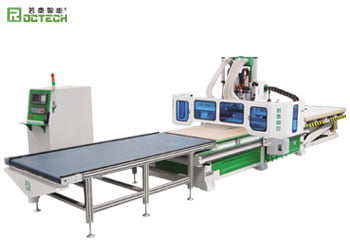
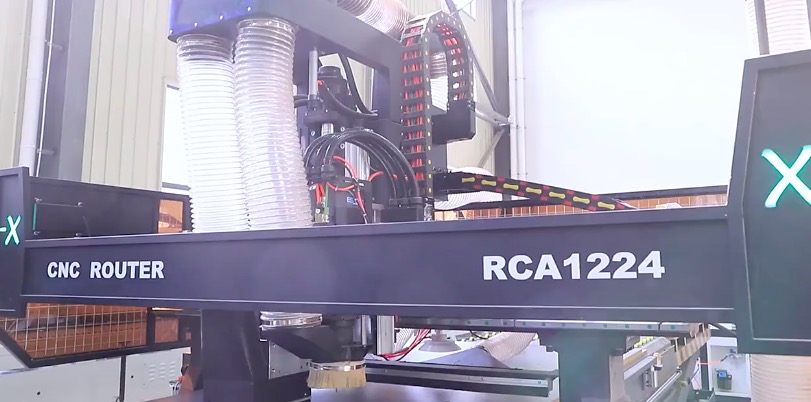
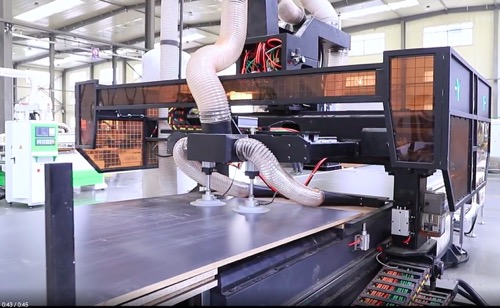
The table above reveals a critical insight: labor cost per machine-hour in the United States is more than three times that of coastal China. Yet, the gap in total production cost is narrower than most import-dependent buyers assume. A U.S. shop running an automated line at 70% utilization can achieve a labor cost per part that is competitive with a Chinese shop using semi-manual equipment, primarily because the U.S. operator supervises more machine hours. This economic reality drives the strong demand for automatic loading and unloading systems in high-wage countries. When a machine such as Roctech’s RCA1224 nesting center performs automatic sheet loading, part labeling, and tool changes, the operator’s role shifts from physically tending the spindle to managing the queue of materials and reviewing output quality. That shift reduces the effective labor cost per part by 40% to 55% in most installations.
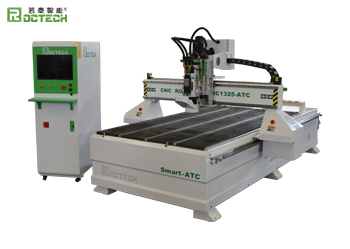
Beyond the hourly wage, the skill premium is a hidden cost. A novice operator may require 160 hours of training before achieving acceptable reject rates on stone or hardwood. During this period, scrap material and spindle crashes can easily offset the savings from a lower starting salary. Experienced operators, particularly those who can write and edit G-code, earn a 15% to 25% premium over basic machine tenders. This is where machine design influences labor economics. A control system that supports conversational programming and provides visual tool-path simulation allows a shop to hire a technician with less formal CNC training. Roctech’s integration of the Syntec control platform on its ATC and five-axis series exemplifies this trend. By standardizing the human-machine interface across models—from the RC1325S-ATC engraving machine to the RCF1325 five-axis machining center—the company reduces retraining costs when a shop scales up or changes product lines. An operator who masters one Roctech controller can transfer that knowledge to another model with minimal supervision.
The second major cost variable is shift utilization. In a two-shift operation, the annual operator cost per machine-hour drops by roughly 35% compared to a single-shift shop, because the fixed portion of wages is spread across more hours. Yet, many small fabrication shops in North America run only one shift due to the difficulty of finding reliable second-shift operators. Automation directly addresses this bottleneck. The six-sided drill and row drill systems offered by Roctech, for instance, enable a single evening operator to run a cabinet production line that would otherwise require three or four workers during the day. The QR-code scanning feature on
Looking for more information about our CNC machines and services? Contact us today.
Contact
Previous:High-Efficiency Production: The Automation Imperative in Modern CNC Fabrication
Next:Five-Axis Machining in the Wood and Mold Industries: A Case Study of the RCF1325