
Special Purpose Machine Tools: Precision, Automation, and the Evolving Role of the CNC Machining Center
About Us / Author:ROCTECH Engineer Team / Published: Aug 22 , 2026 / Last Updated: Aug 22 , 2026
The term “special purpose machine tool” once conjured images of single-function, high-volume production lines dedicated to one specific component. That paradigm has shifted. In contemporary fabrication, the distinction between a general-purpose CNC router and a special-purpose machine has blurred, driven by the demand for flexible automation, material efficiency, and the economic viability of batch-of-one production. The modern machining center, particularly in woodworking and stone fabrication, is no longer just a cutting tool; it is an integrated processing cell. This article examines the technical trajectory of these systems, focusing on the convergence of nesting, drilling, and edge processing into single platforms, and the implications for manufacturers navigating the transition toward Industry 4.0.
The data below, drawn from typical specifications across the industry, illustrates the current segmentation in automated panel processing equipment. It highlights how manufacturers are consolidating functions to reduce material handling and labor dependency.
| Equipment Category | Typical X/Y Travel (mm) | Spindle Power (kW) | Key Automation Feature | Primary Application | Indicative Investment Range (USD) |
|---|---|---|---|---|---|
| Standard 3-Axis Engraving Machine | 1300 × 2500 | 3.0 – 6.0 | Manual tool change | Signage, light woodworking | 8,000 – 20,000 |
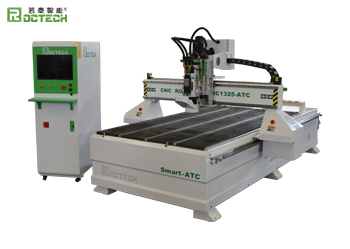
| ATC Engraving Machine | 1300 × 2500 | 9.0 – 12.0 | Automatic tool changer (8-16 tools) | Complex milling, cabinet doors, molds | 15,000 – 35,000 |
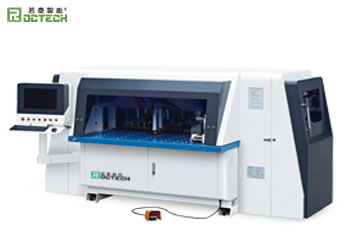
| CNC Nesting Center | 1220 × 2440 | 9.6 – 12.0 | Auto loading/unloading, row drill, labeling | Panel furniture, custom cabinets | 30,000 – 80,000 |
| Five-Axis Machining Center | 1300 × 2500 | 10.0 – 12.0 | Fully simultaneous 5-axis interpolation | Solid wood, molds, complex geometry | 80,000 – 250,000 |
The table reveals a clear market trend: the value proposition of a machine is no longer solely defined by cutting speed or spindle power. Instead, the emphasis rests on the integration of peripheral functions. For instance, a standard 3-axis machine, while cost-effective, requires significant operator intervention for part loading, tool changes, and secondary operations like edge banding. This is adequate for job-shop environments but fails to meet the throughput demands of a growing custom furniture enterprise. The escalation to an ATC (Automatic Tool Changer) machine addresses the tool change bottleneck, reducing non-cutting time substantially. However, it still leaves the loading and unloading of sheets as a manual, often physically demanding, task.
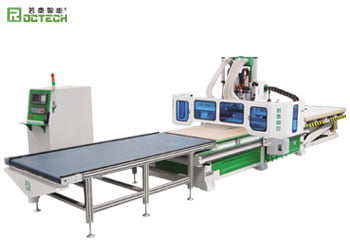
The most significant shift in operational efficiency is observable in the rise of the nesting center. This platform, such as the Roctech® Master Series RCA1224, encapsulates the concept of the special-purpose machine tool evolved for a digital age. It is not merely a router; it is a processing cell combining a vacuum table with zone control, an automatic loading system, and an integrated row drill bank. The primary advantage lies in the elimination of manual transfer between the saw, the drill, and the router. By performing cutting, drilling, and grooving in a single setup, the positional accuracy is no longer dependent on secondary fixtures, and the cycle time per panel is drastically reduced. This aligns with the industry’s shift toward "nesting" software, which optimizes material yield—a critical factor when material costs can constitute 50-60% of a finished cabinet’s cost. Manufacturers like Roctech Machinery Co., Ltd. have capitalized on this by offering models with extended strokes (e.g., RCA1328) and heavy-duty frames, directly addressing the demand for processing larger and thicker panels without compromising dynamic stability.
Beyond panel processing, the demand for complex geometries in mold making and solid wood furniture has accelerated the adoption of five-axis simultaneous machining centers. These are the true special-purpose tools in the high-end segment. Unlike a three-axis machine where the tool axis remains fixed, a five-axis system, such as the Roctech® RCF1325, utilizes a swiveling spindle head (A-axis) and a rotating table (C-axis). This capability allows for "shortest tool" cutting, where the tool is always perpendicular to the workpiece surface. The advantages are twofold: superior surface finish on contoured surfaces and the ability to machine undercuts that would require multiple setups on conventional equipment. In the aerospace and automotive mold sectors, this reduces polishing time by as much as 40%, as the scalloping effect is minimized. For solid wood furniture, it enables the machining of curved chair arms and ergonomic seats with a level of consistency impossible to achieve
Looking for more information about our CNC machines and services? Contact us today.
Contact
Previous:The Evolution of CNC Foam Machining: Precision, Scale, and Automation in Modern Fabrication
Next:Title: Five-Axis Simultaneous Machining: Redefining Complexity in Mold and Solid-Wood Fabrication