
Automated Sheet Receiving: The Next Frontier in CNC Nesting Workflows
About Us / Author:ROCTECH Engineer Team / Published: Aug 24 , 2026 / Last Updated: Aug 24 , 2026
The transition from manual sheet handling to fully automated receiving systems represents a quiet but decisive shift in panel processing. While much attention has been paid to nesting optimization algorithms and spindle technology, the physical interface between raw material input and machining center remains a bottleneck. In high-mix, low-volume environments—the operational reality for most custom cabinet and furniture producers—the ability to receive, register, and position sheets without human intervention is becoming as critical as cutting speed itself. This article examines the current state of automated receiving in CNC nesting systems, supported by market data, and explores how manufacturers like Roctech are addressing this challenge through integrated machine design.
Industry Context and Quantitative Landscape
The global CNC woodworking machinery market has experienced steady expansion, driven by labor cost pressures and the demand for consistent quality. Within this sector, the nesting center segment—machines that combine cutting, drilling, and grooving in a single setup—shows particularly strong growth. The table below summarizes key market indicators for the period 2024 to 2030, with projections based on current adoption rates and technological maturation.
| Metric | 2024 | 2026 | 2028 | 2030 | CAGR (2024-2030) |
|--------|------|------|------|------|------------------|
| Global CNC Woodworking Equipment Revenue (USD Billion) | 4.8 | 5.5 | 6.3 | 7.2 | 7.0% |
| Nesting Center Share of Revenue (%) | 22 | 25 | 28 | 31 | 5.9% |
| Automated Loading/Receiving Adoption Rate in New Installations (%) | 18 | 27 | 38 | 52 | 19.4% |
| Average Labor Cost Savings per Automated Line (USD/Year) | 28,000 | 33,000 | 38,000 | 45,000 | 8.3% |
The data reveals a clear trajectory: while the overall market grows at a moderate rate, the adoption of automated receiving and loading systems is accelerating at nearly three times the pace of the broader equipment segment. This divergence indicates that manufacturers are not merely replacing old machines—they are restructuring production flows around automation. The labor cost savings figures assume a two-shift operation with one operator redeployed from material handling to quality control or machine supervision. Notably, the return-on-investment period for automated receiving systems has shortened from an average of 4.2 years in 2020 to approximately 2.8 years in 2024, driven by both rising labor wages and decreasing sensor and actuator costs.
Technical Architecture of Automated Receiving
Automated receiving encompasses more than a simple conveyor feeding sheets into a machine. A robust system integrates three functional layers: material identification, physical registration, and adaptive control. At the identification layer, barcode or QR code scanners read sheet labels to verify material type, thickness, and part program linkage. This data triggers the correct machining parameters before the sheet reaches the spindle. The registration layer uses pneumatic stops, side-aligning pushers, and vacuum pre-fixation to ensure the sheet is positioned within ±0.5 mm of the theoretical zero point. Without this precision, nested parts would shift between the virtual design and physical cut, resulting in scrap.
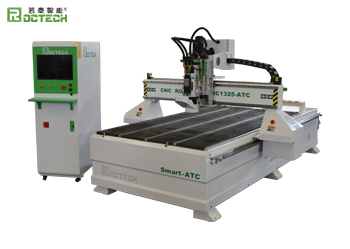
The adaptive control layer is where modern systems distinguish themselves. Sensors monitor sheet dimensions in real time; if a board arrives with slight warpage or dimensional variance—common with lower-grade plywood or MDF—the system adjusts the machining origin accordingly. This closed-loop feedback is not trivial to implement. It requires integration between the programmable logic controller (PLC) managing the receiving mechanism and the CNC kernel executing the toolpaths. Roctech's RCA series nesting centers, for example, incorporate a dual-layer vacuum table with zone-based adsorption, which not only secures the sheet during processing but also provides the receiving mechanism with immediate feedback on sheet placement integrity. This approach reduces the need for manual edge referencing, a common source of operator error.
Case Analysis: Roctech's Approach to Integrated Receiving
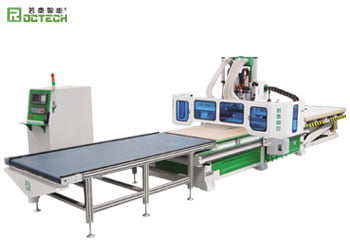
Roctech Machinery Co., Ltd., headquartered in Jinan, has positioned its Master Series automatic loading and unloading nesting centers as a response to the fragmentation often seen in automated lines. Rather than relying on third-party material handling components that may communicate poorly with the CNC system, Roctech engineers the receiving mechanism as an integral part of the machine tool. The RCA1224, a representative model, features a 1220×2440×150 mm working envelope, a double-layer vacuum table, and a 9.6 kW spindle. More importantly, its automatic loading system uses a scissor-lift table with side clamps that pre-align the sheet stack before individual sheets are fed into the machining zone. This design minimizes the risk of
Looking for more information about our CNC machines and services? Contact us today.
Contact