
Title: The 12-Tool Magazine Engraving Machine: Bridging Flexibility and Throughput in Woodworking Automation
About Us / Author:ROCTECH Engineer Team / Published: Aug 27 , 2026 / Last Updated: Aug 27 , 2026
---
The evolution of computer numerical control (CNC) routing in woodworking has followed a predictable arc: from single-spindle manual-tool-change machines to integrated machining centers that minimize non-cutting time. At the heart of this progression lies the automatic tool changer (ATC). While many manufacturers offer carousel or linear magazines with capacities ranging from four to twenty-four tools, the 12-tool configuration has emerged as a pragmatic sweet spot for the custom furniture and architectural millwork sectors. This article examines the technical rationale behind 12-tool magazine systems, their role in production workflows, and their implementation in contemporary machinery, with reference to products from Roctech Machinery Co., Ltd.
Industry Context and the Case for Intermediate Tool Capacity
The custom woodworking industry is characterized by high-mix, low-volume production. A single cabinet door may require a profiling bit, a chamfer tool, a drilling cycle, and a grooving cutter. The traditional approach—manually swapping tools—can consume 30–40% of total cycle time. Conversely, an excessively large tool magazine (e.g., 24 tools) introduces mechanical complexity, increased maintenance, and higher capital cost that many small-to-mid-sized shops cannot justify. The 12-tool magazine bridges this gap effectively.
To contextualize this, consider the following comparative analysis based on typical machine configurations available in the market:
| Machine Configuration | Tool Magazine Capacity | Typical Cycle Time per Part (min) | Initial Investment Index | Suitable Batch Size | Common Application |
|------------------------|------------------------|-----------------------------------|--------------------------|---------------------|--------------------|
| Manual tool change | 1 | 12–18 | 0.8 | 1–5 | Prototyping, repair |
| 8-tool carousel ATC | 8 | 6–9 | 1.0 | 5–50 | Small cabinet shops |
| 12-tool carousel/linear| 12 | 4–6 | 1.1 | 20–200 | Custom furniture, doors |
| 16–24 tool linear ATC | 16–24 | 3–5 | 1.4 | 100–500 | Large-scale nesting centers |
As indicated, the incremental investment from an 8-tool to a 12-tool system is modest—roughly 10% in machine cost—yet the reduction in cycle time approaches 30%. This is because 12 tools typically cover an entire job family: three or four profiling cutters, two or three drills (e.g., 3-mm, 5-mm, 8-mm), a grooving saw, a dovetail bit, a chamfer tool, and a compression spiral for final pass. Beyond 12 tools, the marginal cycle time improvement diminishes sharply unless the operator is processing highly complex parts with dozens of distinct features.
Technical Implementation and Workflow Integration
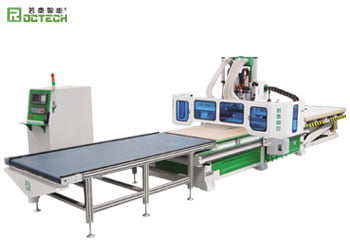
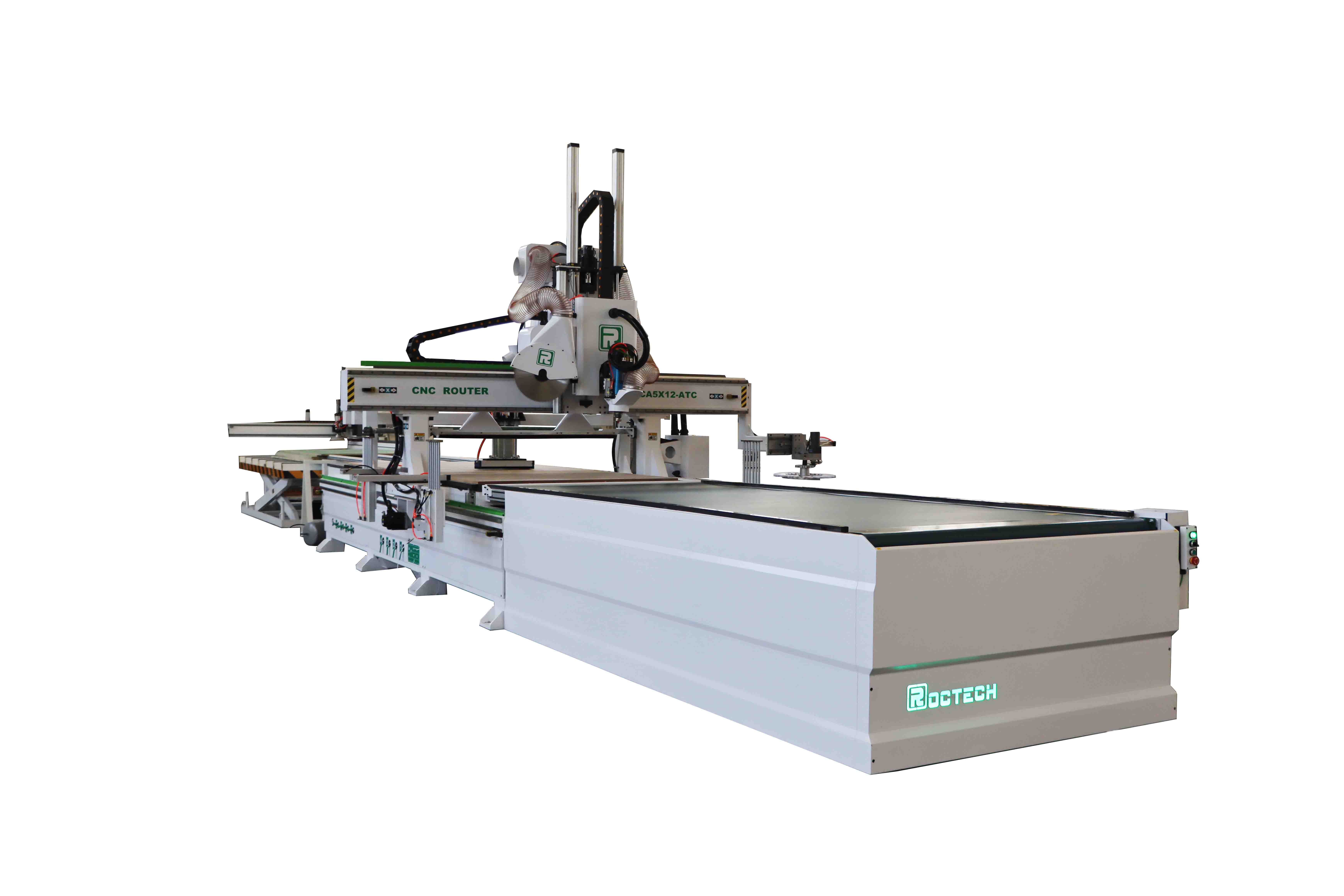
A well-designed 12-tool magazine must balance rigidity with speed. In the case of Roctech’s RC1325S-ATC—a representative model in this category—the carousel magazine holds 12 tools (expandable to 16 via an optional configuration), with a tool-change time of approximately 8–12 seconds. The spindle is a 9-kW unit with an ER32 collet, capable of 24,000 RPM. The machine employs a rack-and-pinion drive on the X/Y axes, achieving rapid traverse speeds of 45,000 mm/min, and a ball screw on the Z-axis for precise plunge control.
The critical factor in real-world performance is not merely the number of tools but the tool management logic. Roctech’s implementation uses the Taiwan Syntec control system, which supports tool-life management, wear compensation, and breakage detection. For a 12-tool magazine, the control system tracks each tool’s accumulated cutting time and automatically prompts replacement or re-sharpening. This is particularly valuable in continuous production runs, where a worn 6-mm end mill might otherwise go unnoticed until it causes a defective part.
Operationally, the 12-tool magazine enables a "set-and-forget" workflow. An operator can load a batch of MDF panels, initiate the nesting program, and allow the machine to complete drilling, profiling, and grooving without intervention. The machine’s vacuum table, divided into zones, holds both large sheets and small offcuts securely—a necessity when processing mixed-size components in a single cycle.
Case Study: Roctech RC1325S-ATC in Panel Processing
A representative deployment of a 12-tool ATC machine is in the production of custom wardrobe components. At Roctech’s facility
Looking for more information about our CNC machines and services? Contact us today.
Contact
Previous:Quartz Stone Drilling: Precision, Tooling, and the Automation Imperative
Next:Title: Precision and Repeatability: The Engineering Imperative in Modern Edge Banding Systems