
Title: Precision and Repeatability: The Engineering Imperative in Modern Edge Banding Systems
About Us / Author:ROCTECH Engineer Team / Published: Aug 27 , 2026 / Last Updated: Aug 27 , 2026
The contemporary panel furniture manufacturing line is no longer a collection of isolated processing stations but an integrated flow of continuous, high-throughput operations. Within this ecosystem, the edge banding machine represents a critical bottleneck—a point where the aesthetic quality of the final product is determined. While the cutting and nesting processes dictate dimensional accuracy, it is the edge banding unit, specifically its pressing mechanism, that defines the tactile and visual seamlessness of the finished panel. This article examines the technical evolution of the edge banding pressing mechanism, analyzing its role in the context of automated production and material science.
The pressing mechanism’s function appears deceptively simple: to apply uniform pressure to the edge banding tape against the substrate until the adhesive sets. However, the physics involved are complex, particularly when operating at feed speeds exceeding 20 meters per minute. The mechanism must accommodate varying panel thicknesses, handle different tape materials—from PVC to solid wood veneer—and compensate for the thermal dynamics of hot-melt adhesives. A failure in this subsystem leads to delamination, glue seepage, or visible glue lines, all of which are unacceptable in high-end cabinet production.
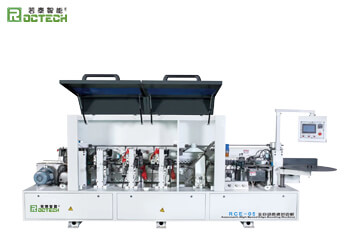
Modern systems employ a multi-stage pressing arrangement. The initial section uses a series of spring-loaded rollers that provide a pre-pressing function, ensuring the tape is correctly aligned and tacked before the main pressure is applied. This is followed by a rigid, pneumatically or servo-controlled pressure beam. This beam is the core of the mechanism. Its rigidity must be absolute to prevent deflection, which would cause inconsistent pressure across the panel’s length. High-end machines, such as those produced by Roctech Machinery Co., Ltd., integrate precision-ground pressure rollers with independent pneumatic cylinders. This allows for zone-specific pressure adjustment, compensating for minor panel surface irregularities without crushing the core material.
The selection of the pressure medium is a key engineering decision. Pneumatic systems are favored for their compliance and shock absorption, essential for handling panels with slight thickness tolerances. Yet, they introduce a delay in response time. Servo-electric systems offer greater precision and repeatability, facilitating digital control over pressure curves. The latest trend is toward hybrid systems, where a servo-driven main beam provides the base pressure, and pneumatic tips on the rollers offer a final, conforming touch. This level of control is vital when applying thick, rigid tapes like ABS or when processing panels with melamine surfaces that are susceptible to pressure marks.
Data from industry surveys indicates a direct correlation between the sophistication of the pressing mechanism and production yield. The table below illustrates the operational differences across machine classes:
| Feature / Machine Class | Semi-Automatic (Entry) | Automatic (Mid-Range) | High-Speed / CNC (Premium) |
| :--- | :--- | :--- | :--- |
| Feed Speed (m/min) | 4 – 8 | 12 – 18 | 20 – 30 |
| Pressing Control | Fixed Mechanical Springs | Pneumatic Cylinders | Servo-Pneumatic Hybrid |
| Pressure Adjustment | Manual, Offline | Manual, During Setup | Automatic, Programmable per Panel |
| Roller Configuration | Single Row, Fixed Position | Two Rows, Adjustable Height | Multiple Rows, Independent Pressure Zones |
| Typical Application | Small Shops, Repair | Batch Furniture Production | Mass Customization, High-End Cabinetry |
| Defect Rate (Glue/Seam) | 1.5% – 3% | 0.8% – 1.5% |< 0.5% |
The data clearly shows that while entry-level machines rely on fixed mechanical force, they are adequate for low-volume work. The transition to pneumatic systems in mid-range machines offers adjustability but relies on operator skill. The premium segment, however, moves toward digital control. This allows for the “recipe management” of pressure profiles, where parameters are stored digitally and recalled on demand. For instance, a panel with a honeycomb core requires far less pressure than a solid MDF board to prevent crush. A modern system, such as those integrated into Roctech’s advanced edge banding series, can auto-adjust pressure based on the scan code of the incoming panel, ensuring optimal processing with zero manual intervention.
Furthermore, the thermal aspect cannot be ignored. The pressing mechanism must work in concert with the pre-milling and glue application units. In Roctech’s edge banding solutions, the pressing rollers are positioned precisely to apply force immediately after the glue is spread and the tape is applied, capitalizing on the open time of the EVA or PUR adhesive. The use of tangential pressure, rather than purely vertical, helps in expelling trapped air, a common cause of blistering on dark melamine edges. The mechanical stability of
Looking for more information about our CNC machines and services? Contact us today.
Contact