
Indonesia’s Woodworking Machinery Market: Automation, Nesting, and the Push for Industry 4.0
About Us / Author:ROCTECH Engineer Team / Published: Sep 03 , 2026 / Last Updated: Sep 03 , 2026
The Indonesian woodworking sector stands at a critical inflection point. Driven by a sustained domestic housing boom, the expansion of the hospitality sector, and a strategic government push to increase value-added timber exports, manufacturers across Java, Sumatra, and Kalimantan are under immense pressure to modernize. The biennial Indonesia International Woodworking Machinery & Furniture Accessories Exhibition—often regarded as the primary gateway for technology adoption in the archipelago—recently underscored a decisive shift: the transition from conventional, labor-intensive processing to automated CNC-driven fabrication. This article examines the market dynamics informing this shift, evaluates the technical trajectory of key equipment categories on display, and contextualizes the role of established suppliers such as Roctech within the region’s evolving production landscape.
Market Context and Regional Data
The demand for panel furniture, particularly for the middle-class housing segment, continues to outpace the output capabilities of traditional workshops. Consequently, import statistics for woodworking machinery have shown a compound annual growth rate of over eight percent in the past three years, with China, Taiwan, and Germany remaining the dominant sources. However, the composition of imports is changing. While the past decade was defined by standalone spindle engravers and basic panel saws, current procurement lists emphasize integrated solutions: automatic nesting centers, through-feed edge banders, and six-sided CNC drilling centers. A survey of exhibitors at the recent Jakarta show reveals the following allocation of technology interest among Indonesian fabricators:
| Technology Category | Share of Visitor Inquiries (%) | Primary Application | Typical Investment Range (USD) |
|---------------------|--------------------------------|---------------------|--------------------------------|
| Automatic Loading/Unloading Nesting Centers | 38 | Panel furniture, custom cabinetry | 45,000 – 120,000 |
| ATC Engraving Machines (Carousel/Linear) | 27 | Door panels, decorative moldings, acrylic | 15,000 – 40,000 |
| Six-Sided / Five-Sided CNC Drilling Centers | 21 | Batch production of case goods | 60,000 – 150,000 |
| Edge Banding & Finishing Lines | 14 | Cabinet doors, shelving | 20,000 – 80,000 |
The data indicates a decisive move away from single-process standalone machines. The high interest in nesting centers—nearly forty percent of all qualified leads—reflects a fundamental operational bottleneck: material utilization and labor dependency. For Indonesian manufacturers facing rising minimum wages in industrial zones near Jakarta and Surabaya, the economics of automating the loading, cutting, and labeling process have become compelling. A mid-sized operation producing kitchen cabinets, processing roughly 2,000 sheets of 18mm MDF monthly, can achieve a payback period of under eighteen months on a fully automated nesting cell, primarily through a 15–20 percent reduction in raw material waste and a 30 percent decrease in direct labor requirements.
Technical Trajectory and Application in the Indonesian Context
The technical features demanded by Indonesian buyers differ notably from those in mature markets like Germany or Japan. The tropical climate, characterized by high humidity, places a premium on robust anti-corrosion treatments for guide rails and beds. Additionally, the prevalence of mixed-species hardwood processing—ranging from rubberwood, which is widely cultivated in Sumatra, to tropical hardwoods used in outdoor furniture—necessitates greater spindle torque and more aggressive dust extraction capabilities. Exhibitors responding to these needs are increasingly featuring heavy-duty welded structures with Taiwan HIWIN linear guides and Japan Yaskawa servo systems, a configuration that balances rigidity and positional accuracy under fluctuating power grid conditions.
One of the most significant trends observed is the integration of the nesting center into a broader production network, rather than operating as a stand-alone island of automation. Data interoperability is no longer optional. Indonesian manufacturers are demanding seamless handshakes between design software (such as Cabinet Vision or the widely used domestic Chinese nesting programs) and the machine’s control system. The ability to scan a QR code printed during the nesting process, which then drives a downstream six-sided drilling center to execute precise dowel and cam-lock boring patterns, has transitioned from premium feature to standard expectation. This aligns with the broader regional movement toward “mass customization,” where the efficiency of batch production is reconciled with the variability of one-off cabinetry orders.
Supplier Strategies and Brand Positioning
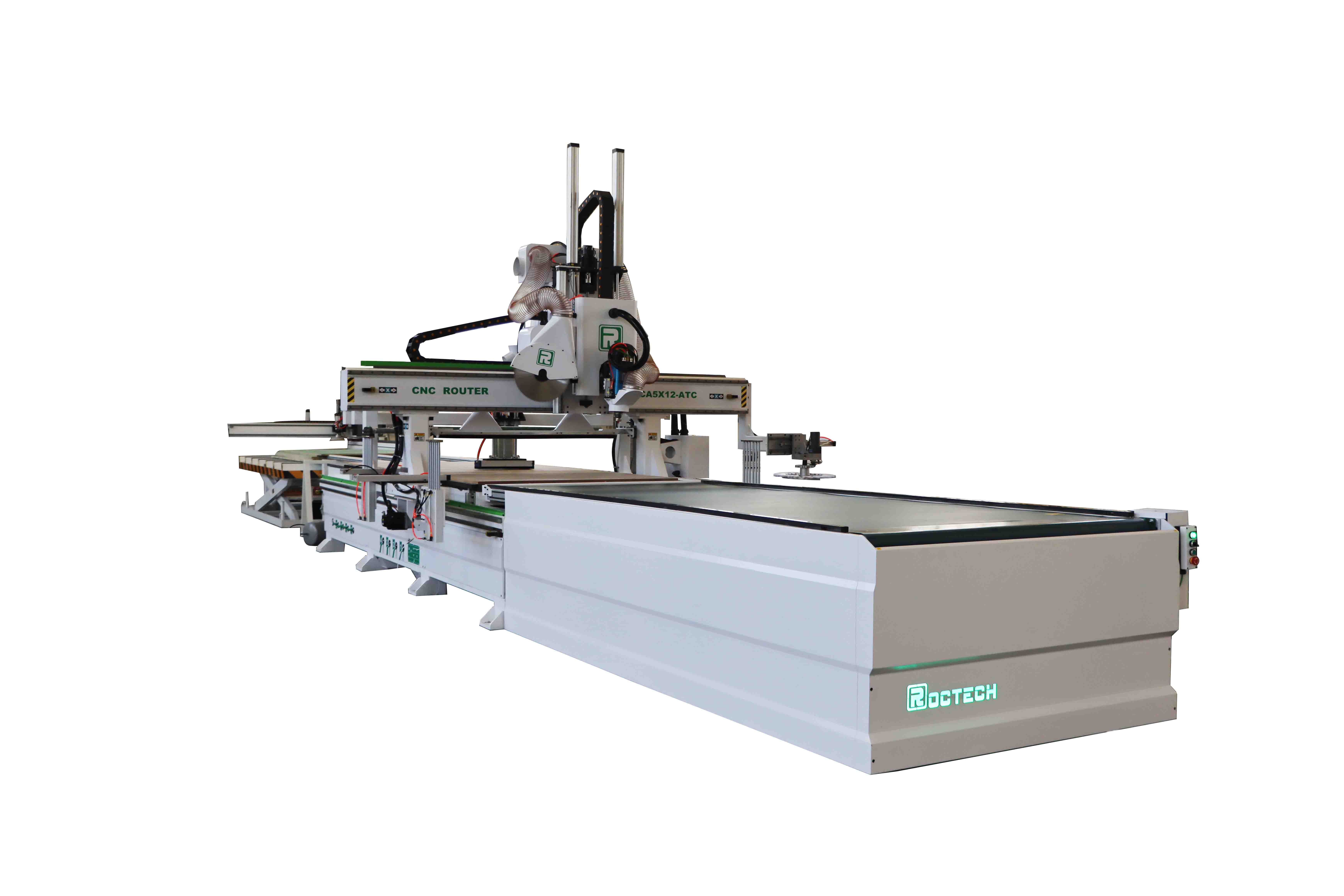
Within this competitive landscape, the presence of established Chinese manufacturers remains prominent. Roctech Machinery Co., Ltd., which has cultivated a distribution network across Southeast Asia for over a decade, has positioned its product line to directly address the Indonesian market’s intermediate automation needs. For instance, the RCA series automatic loading and unloading nesting centers, often showcased at these exhibitions, provide a critical on-ramp for workshops transitioning from manual routing. By incorporating a double-layer vacuum table with
Looking for more information about our CNC machines and services? Contact us today.
Contact
Previous:The Evolution of Large Woodworking Machining Centers: Precision, Automation, and Market Dynamics
Next:Title: The 15kW Fiber Laser Frontier: Reshaping Fabrication Economies and Machine Design