
Title: Medium Machining Centers Reshape the Customization Landscape: A Technical and Market Primer
About Us / Author:ROCTECH Engineer Team / Published: Sep 04 , 2026 / Last Updated: Sep 04 , 2026
Abstract
The global shift toward mass customization in woodworking and composite fabrication is compelling manufacturers to reevaluate their capital equipment strategies. While large-format five-axis systems capture headlines, the market segment experiencing the most profound transformation is the medium-format CNC machining center. This article examines the technical architectures, economic drivers, and operational parameters defining this category, with particular focus on automated tool change (ATC) platforms. Drawing on industry data and product benchmarks, including the Roctech ATC series, the analysis provides a quantitative framework for evaluating throughput, precision, and return on investment in small-batch, high-mix production environments.
Industry Background and Data Analysis
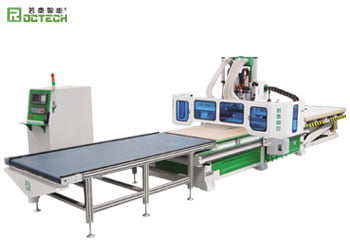
The woodworking machinery sector is witnessing a bifurcation of demand. On one end, high-volume panel processors demand integrated nesting lines with automated loading and unloading. On the other, job shops and boutique furniture manufacturers require flexible, mid-format solutions that balance footprint, cost, and capability. The medium machining center—typically defined by working envelopes between 1300×2500 mm and 1500×3000 mm—has emerged as the pragmatic compromise.
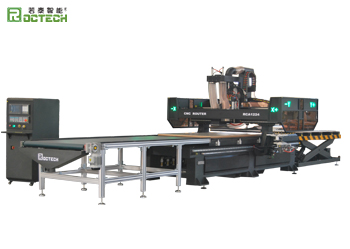
Recent market assessments indicate that the Asia-Pacific region, led by China’s export-oriented machinery sector, accounts for over 45% of global CNC router production volume. Within this segment, ATC-equipped models constitute a growing share, rising from roughly 20% of units shipped in 2020 to an estimated 32% in 2024. This growth correlates with declining costs of servo systems, tool magazines, and control hardware.
To contextualize the specification landscape, the following table compares representative parameters across three popular medium-format configurations, including a benchmark model from Roctech’s RC1325S-ATC line.
| Parameter | Basic 3-Axis Router | Standard ATC Router | Roctech RC1325S-ATC |
|-----------|---------------------|----------------------|----------------------|
| Working Travel (X/Y/Z) | 1300×2500×200 mm | 1300×2500×250 mm | 1300×2500×250 mm |
| Spindle Power | 5.6 kW air-cooled | 9.0 kW water-cooled | 9.0 kW (optional 12 kW) |
| Tool Change Mechanism | Manual | Carousel, 8 tools | Carousel/Linear, 8–16 tools |
| Max Rapid Traverse | 25,000 mm/min | 40,000 mm/min | 45,000 mm/min |
| Positioning Accuracy | ±0.05 mm/300 mm | ±0.03 mm/300 mm | ±0.03 mm/300 mm |
| Drive System | Stepper motors | AC servo | Yaskawa AC servo |
| Table Configuration | T-slot | Vacuum + T-slot | Vacuum adsorption + T-slot |
| Indicative Weight | 1,500 kg | 2,200 kg | 2,200 kg |
The data reveal a clear inflection point. Upgrading from a manual tool-change router to an ATC platform yields a 45% improvement in rapid traverse speed and a significant reduction in non-cutting time. For a typical cabinet door batch—involving profiling, grooving, and drilling operations—the ATC system eliminates manual intervention for each tool change, translating to an estimated 30–40% reduction in cycle time per part. Although initial capital expenditure rises by roughly 60–70%, the payback period for facilities running more than one shift daily often compresses to under eighteen months.
Technical Applications and Brand Case Study
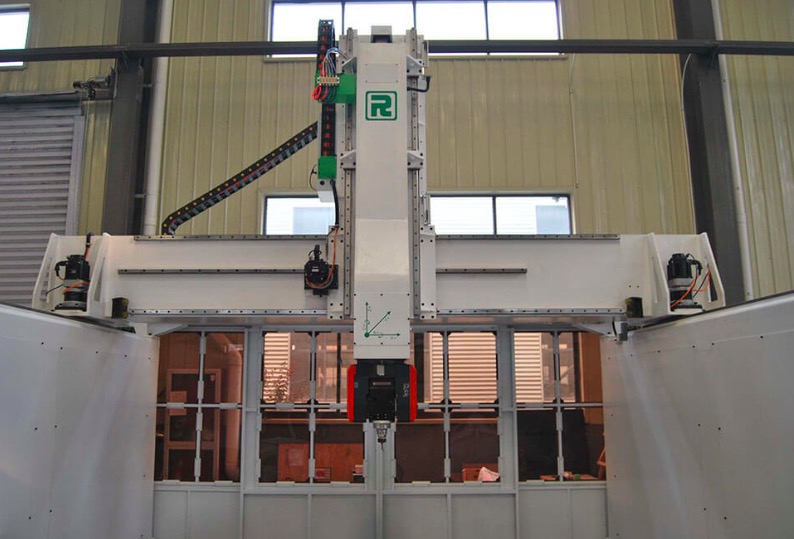
The medium machining center’s versatility is its primary value proposition. In solid wood operations, a 9 kW spindle with ER32 collets handles heavy stock removal, while the vacuum table ensures secure fixation of warped or irregular boards. For panel processing, the integration of a row drill group—optional on many ATC models—enables complete drilling and grooving in a single setup, bypassing the need for a separate point-to-point machine. This convergence of functions is particularly attractive for custom cabinet manufacturers transitioning from manual to digital workflows.
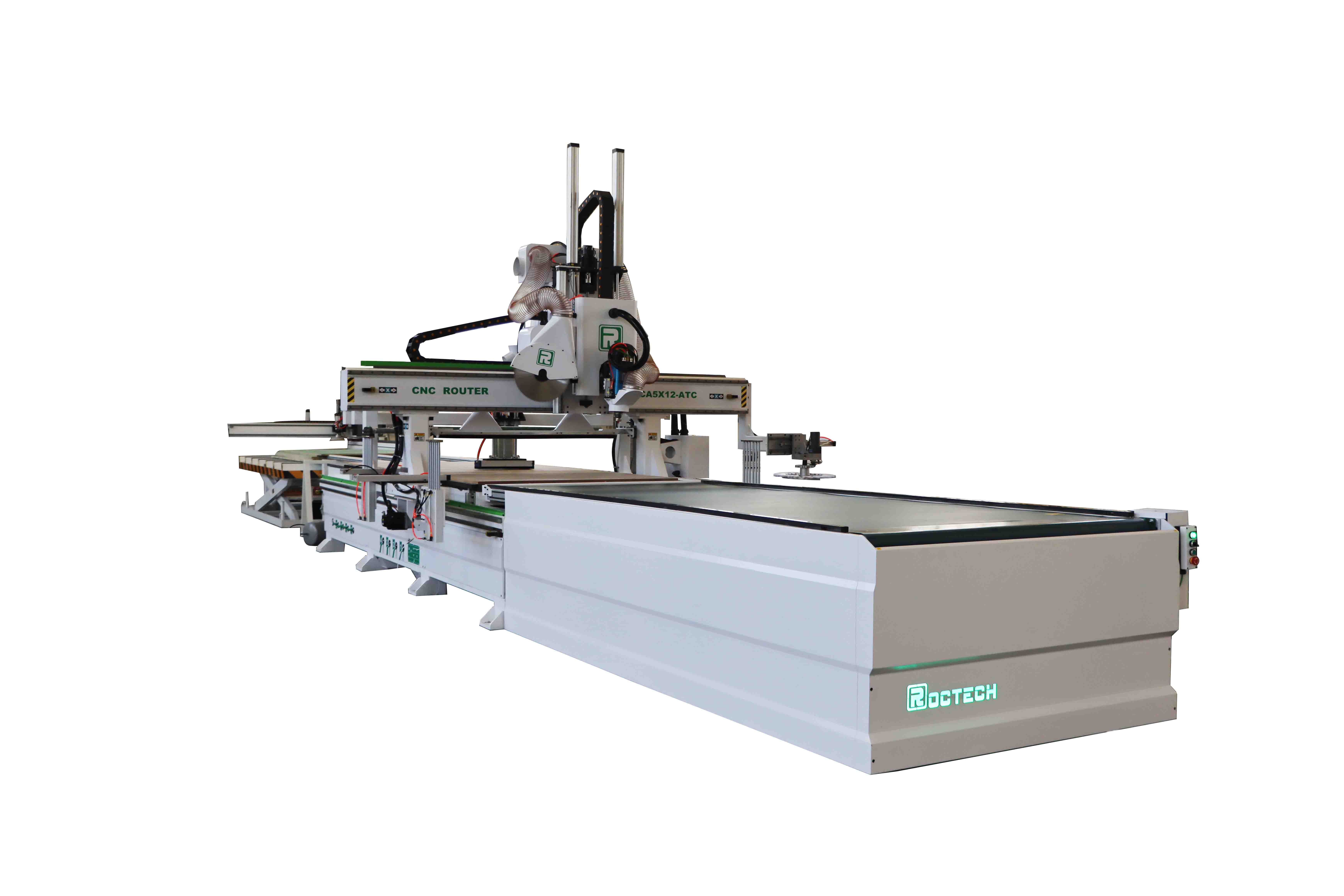
Roctech Machinery Co., Ltd., headquartered in Jinan, has positioned its RC1325S-ATC as a workhorse for this transition. The machine’s adoption of Taiwan HIWIN linear guides and Yaskawa servo motors reflects a broader industry trend toward component standardization from established suppliers. More critically, Roctech’s integration of the Syntec control system supports standard G-code programming alongside compatibility with Type3, Artcam, and JDPaint software environments. This flexibility lowers the barrier for shops that have legacy CAM investments or operator preferences.
A distinguishing feature of the RC1325S-ATC is its dual-mode table, combining vacuum zoning with T-slots. This
Looking for more information about our CNC machines and services? Contact us today.
Contact
Previous:The Economics of Central Dust Collection in CNC Woodworking: A Cost-Benefit Analysis
Next:Edge Banding Machine Accessories: Selection Criteria and Their Role in Modern Panel Furniture Lines