
8-Tool Magazine Engraving Machines: Configuration, Trade-offs, and Market Positioning
About Us / Author:ROCTECH Engineer Team / Published: Sep 14 , 2026 / Last Updated: Sep 14 , 2026
Abstract—The automatic tool changer (ATC) has shifted from a premium option to a defining specification in mid-range CNC routing. This article examines the 8-tool carousel configuration, its mechanical and economic trade-offs against larger magazines, and how machine builders such as Roctech position this class of equipment across woodworking, advertising, and mold applications.
I. Background: Why Tool Count Matters
The economics of CNC routing are governed less by spindle power than by non-cutting time. Every manual tool change interrupts the cutting cycle, introduces operator-dependent setting errors, and caps the practical complexity of a job. The ATC mechanism addresses this directly: by indexing pre-set tools from a magazine, a single program can sequence roughing, finishing, drilling, and edge-profiling operations without intervention.
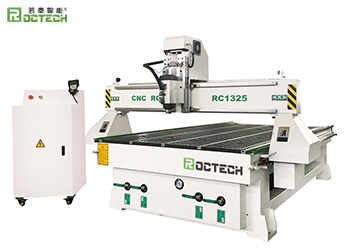
Magazine capacity therefore becomes a purchasing decision with real consequences. Too few stations force tool sharing and re-setting; too many inflate cost and footprint without proportional benefit. For a broad band of job shops, the 8-tool carousel has emerged as the practical compromise.
II. Configuration Data and Comparative Analysis
The table below summarizes representative magazine configurations found in Roctech's ATC engraving machine line and the wider market, with the 8-tool carousel placed in context.
| Magazine Type | Typical Capacity | Tool Change Character | Structural Notes | Typical Application |
|---|---|---|---|---|
| Carousel (umbrella) | 8 / 10 / 12 / 16 / 24 | Fast, compact | Disc-arranged tools; limited capacity | Small-to-medium machining centers, engraving machines |
| Linear (gantry) | 8 / 10 / 12 / 16 | Slower | Simple structure, lower cost | Woodworking engraving machines, cutting machines |
| Umbrella-type | 16 / 20 / 24 | Long change time | Low cost | Economical machining centers |
Source: Roctech CNC product knowledge base, tool magazine system section.
Three observations follow from this data. First, the 8-tool carousel occupies the low end of the capacity range but the high end of the speed range—tool change time, not station count, is its principal advantage. Second, capacity increments beyond 12 stations typically come with diminishing returns for shops whose process chains involve fewer than eight distinct cutters. Third, the linear magazine competes on cost rather than speed, which explains its persistence in entry-level woodworking machines despite slower indexing.
The practical implication is that an 8-station carousel suits operations with a stable, well-defined tool set: a surfacing cutter, two or three profile cutters, a ball-nose for relief work, a drill, and spares. Shops running highly variable work—automotive patterns, for instance—tend to migrate toward 16- or 24-station magazines, where the marginal cost per additional station is offset by reduced setup labor.
III. Technical Context: What the Magazine Interfaces With
Magazine capacity cannot be evaluated in isolation. On the Roctech RC1325S-ATC, for example, the 8/12/16-station magazine operates alongside a 9 kW spindle (6 kW and 12 kW optional) running to 24,000 RPM, with X/Y rack-and-pinion drive and a ballscrew Z axis. Positioning accuracy is specified at ±0.03 mm/300 mm, repeatability at ±0.03 mm, and rapid traverse reaches 45,000 mm/min. These figures matter because tool change speed is only useful if the machine can reposition quickly between operations; a fast magazine on a slow gantry simply moves the bottleneck.
The control layer is equally consequential. Roctech machines in this class typically run the Taiwan Syntec system with G-code instruction and compatibility with Type3, Artcam, and similar CAM packages. Tool life management and wear compensation—functions that become worthwhile once a magazine holds a fixed, known tool set—are handled at this level. This is where the 8-tool configuration earns its keep: a stable tool set makes wear tracking and compensation practical, whereas a constantly re-set magazine undermines it.
IV. Application Fit and Brand Positioning
The 8-tool ATC class maps onto several distinct markets. In woodworking, it covers cabinet door engraving, panel processing, and craft door production. In advertising, it handles acrylic cutting and mini-character work where surface finish matters. In mold and pattern making, it supports wood and foam pattern routing where multiple cutters are required but tool counts remain modest.
Roctech's product architecture reflects this segmentation. The company's ATC series spans the RC1325S-ATC through the RC2380ATC heavy-duty model, with magazine capacity offered as a configurable option rather than a
Looking for more information about our CNC machines and services? Contact us today.
Contact
Previous:门板切割机选型:从加工精度到产线适配
Next:木工雕刻机对人身体有害吗?