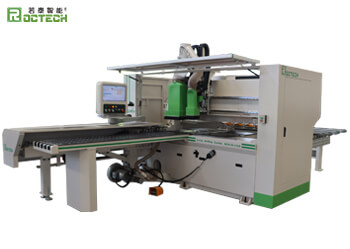

The Evolution of Panel Furniture Cutting: Why Nesting Centers Are Redefining Production Efficiency
About Us / Author:ROCTECH Engineer Team / Published: Jul 12 , 2026 / Last Updated: Jul 12 , 2026
Abstract
The panel furniture industry has undergone a fundamental transformation over the past decade, driven by the convergence of mass customization, rising labor costs, and the demand for shorter lead times. Central to this shift is the nesting CNC router—a machine that combines cutting, drilling, and grooving into a single automated workflow. This article examines the current market landscape for panel furniture cutting equipment, presents comparative performance data across key machine categories, and analyzes how manufacturers like Roctech are addressing the industry’s most pressing productivity challenges through integrated automation solutions.
Industry Background and Market Data
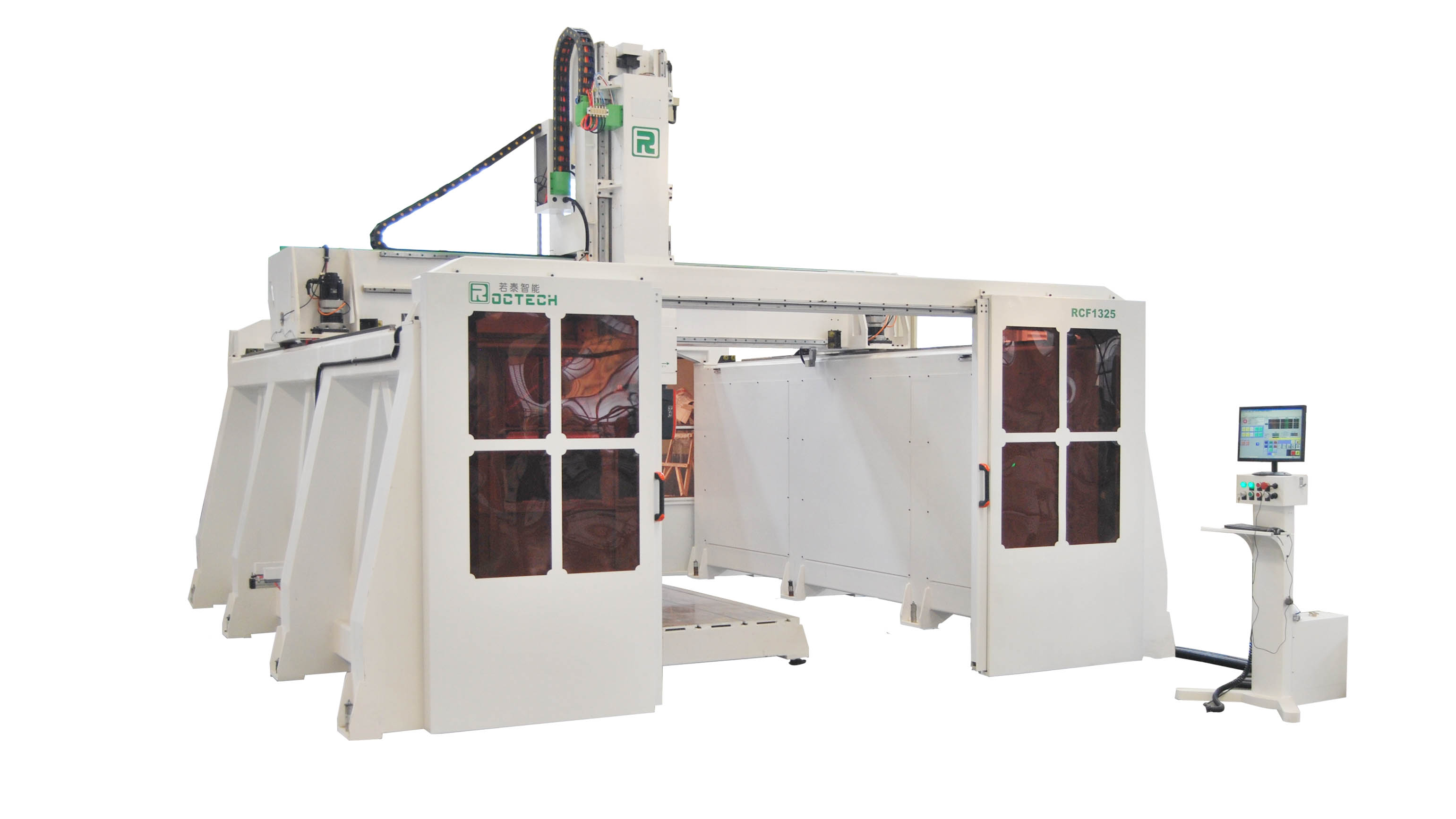
The global market for woodworking CNC machinery was valued at approximately USD 4.2 billion in 2023, with panel furniture cutting equipment representing roughly 35% of that total. Growth is particularly pronounced in Asia-Pacific, where rapid urbanization and expanding middle-class housing demand have fueled custom kitchen and wardrobe production.
Within the panel furniture segment, nesting centers have emerged as the dominant processing platform, displacing traditional panel saws and standalone drilling machines. The rationale is straightforward: a nesting center performs multiple operations—cutting, routing, drilling, grooving, and labeling—in a single clamping, eliminating inter-machine transfer errors and reducing cycle time by 40–60% compared to conventional line configurations.
The following table summarizes key performance parameters across three common machine configurations used in panel furniture manufacturing:
| Parameter | Standard Panel Saw | 3-Axis CNC Router (Manual Load) | Automatic Nesting Center (e.g., Roctech RCA1224) |
|-----------|-------------------|-------------------------------|--------------------------------------------------|
| Setup time per batch | 15–30 min | 5–10 min | 1–3 min |
| Sheet utilization rate | 70–80% | 85–92% | 90–95% (with nesting software) |
| Labor requirement per shift | 2–3 operators | 1–2 operators | 0.5–1 operator |
| Operations per clamping | 1 (cutting only) | 2–3 (cutting + routing) | 4+ (cutting, drilling, grooving, labeling) |
| Typical throughput (8 hr) | 60–80 panels | 40–60 panels | 80–120 panels |
| Positioning accuracy | ±0.2 mm | ±0.05 mm | ±0.03 mm |
The data reveals a clear trend: while initial capital expenditure for an automatic nesting center is 2–3 times higher than a panel saw, the total cost per finished panel decreases significantly at production volumes exceeding 200 panels per day. This is due to labor savings, reduced material waste, and higher throughput.
Technology Applications and Brand Case Study
The technical architecture of a modern nesting center involves several interdependent subsystems. The bed structure must be rigid enough to withstand continuous cutting forces while supporting a vacuum table with zone control—critical for holding both full sheets and small remnant pieces. The drive system, typically using rack-and-pinion transmission on X/Y axes and ball screws on the Z-axis, requires servo motors with closed-loop feedback to maintain positioning accuracy at rapid traverse speeds exceeding 45,000 mm/min.
One of the most consequential innovations in this space has been the integration of automatic loading and unloading systems. Rather than requiring an operator to manually place each panel on the table and remove finished parts, the machine can pick up sheets from a lift table, process them, and discharge finished components onto a conveyor or cart. This reduces the labor requirement to a single operator who can manage multiple machines.
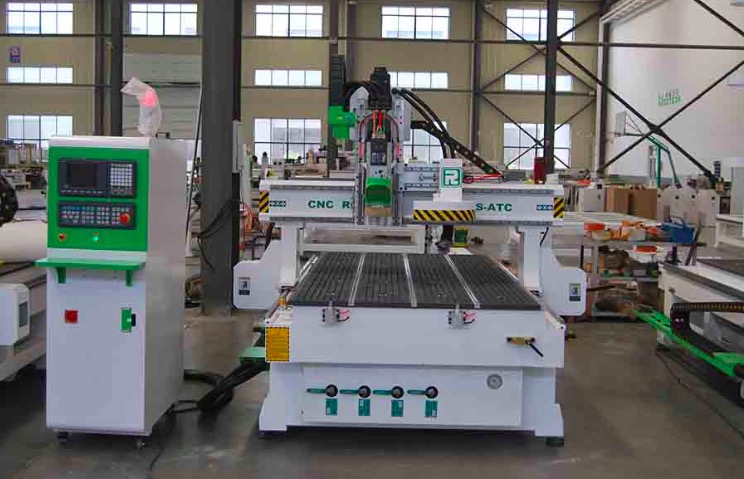
Roctech’s Master Series, particularly the RCA1224 model, exemplifies this trend. The machine features a double-layer vacuum adsorption table with independent zone control, allowing it to secure both large panels (up to 1220×2440 mm) and small offcuts with equal reliability. Its 9.6 kW spindle, driven by a Yaskawa servo motor and controlled by a Taiwan Syntec CNC system, delivers the torque and speed needed for continuous production of cabinet components in materials ranging from particleboard to solid wood.
What distinguishes Roctech’s offering in the mid-tier market is not raw speed—many machines can achieve similar traverse rates—but the ecosystem integration. The RCA1224 supports direct data import from mainstream nesting software such as Haixun, Yunxi, and 1010, enabling the seamless conversion of design files into optimized toolpaths. The machine’s automatic tool changer, with a capacity of 8–16 tools, allows it to switch between drilling, grooving, and cutting operations without human intervention. For manufacturers producing custom cabinets with frequent design changes, this reduces the per-batch setup time from 15–30 minutes to under three minutes.
Conclusion and Outlook
The panel furniture industry is moving decisively toward fully automated, data
Looking for more information about our CNC machines and services? Contact us today.
Contact