
Industry 4.0 in CNC Machining: Automation, Intelligence, and the Future of Fabrication
About Us / Author:ROCTECH Engineer Team / Published: Jul 12 , 2026 / Last Updated: Jul 12 , 2026
Abstract
The global manufacturing sector is undergoing a profound transformation driven by Industry 4.0 principles—cyber-physical systems, Internet of Things (IoT) integration, and data-driven decision-making. For the CNC machining industry, encompassing woodworking, stone engraving, and metal fabrication, this paradigm shift manifests in the evolution from standalone computer numerical control machines to fully integrated, intelligent manufacturing cells. This article examines the current development status of Industry 4.0 adoption within the CNC router and machining center market, presents quantitative market data, and analyzes how leading manufacturers such as Roctech Machinery Co., Ltd. are aligning product strategies with smart factory requirements.
Industry Background: The State of Smart Manufacturing in CNC
Industry 4.0, first conceptualized in Germany in 2011, has moved beyond theoretical frameworks into tangible implementation across discrete manufacturing sectors. In the CNC domain, key enablers include advanced control systems with cloud connectivity, automatic tool management, real-time production monitoring, and seamless integration with enterprise resource planning (ERP) and manufacturing execution systems (MES). The woodworking and stone processing industries, traditionally labor-intensive and reliant on manual skill, are now witnessing accelerated automation adoption driven by labor shortages, rising material costs, and increasing demand for mass customization.
According to recent market analyses, the global CNC machine tools market was valued at approximately USD 78.5 billion in 2023, with the woodworking CNC segment accounting for roughly 18% of this figure. The integration of Industry 4.0 features—such as predictive maintenance, digital twin simulation, and automated material handling—is projected to grow at a compound annual growth rate (CAGR) of 9.2% from 2024 to 2030. The following table summarizes key metrics illustrating the penetration of smart manufacturing capabilities across different CNC equipment categories.
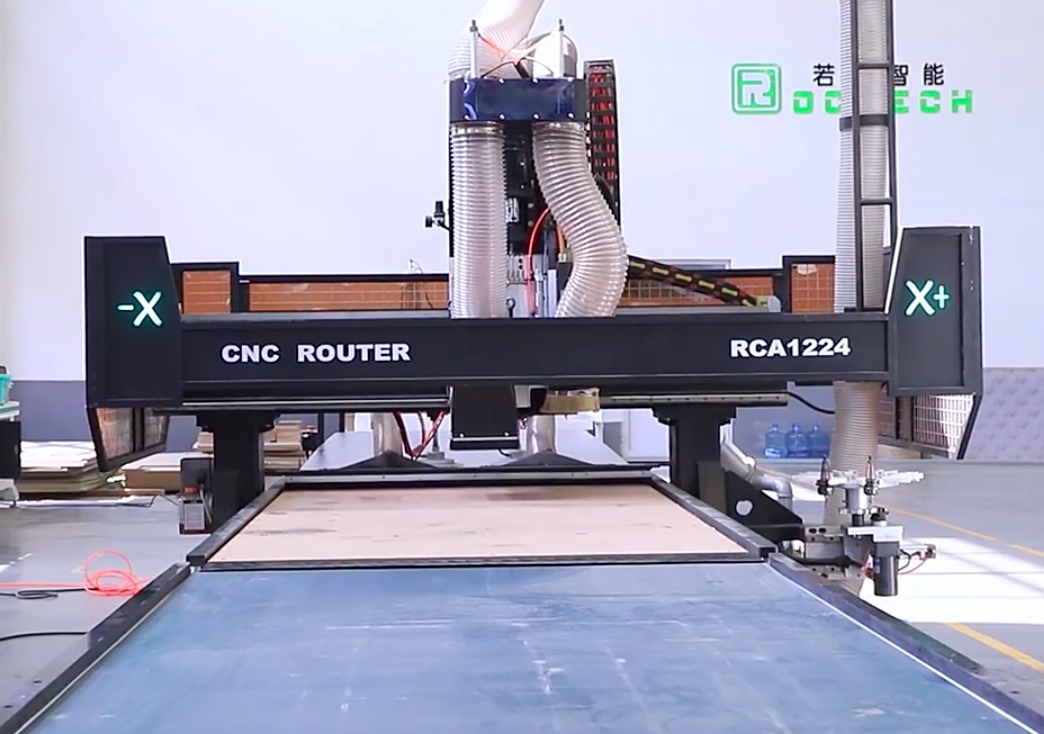
Table 1: Industry 4.0 Feature Adoption in CNC Equipment by Category (2024 Estimate)
| Equipment Category | Market Share (%) | Automation Level (1–5) | IoT Connectivity (%) | Cloud Integration (%) | Predictive Maintenance (%) | Average Price Range (USD) |
|--------------------|------------------|------------------------|----------------------|----------------------|--------------------------|---------------------------|
| 3-Axis Engraving Machines | 32 | 2.5 | 15 | 8 | 5 | 8,000–50,000 |
| ATC Machining Centers | 28 | 3.8 | 45 | 22 | 18 | 30,000–150,000 |
| Nesting Centers (Auto Load/Unload) | 18 | 4.5 | 72 | 55 | 40 | 50,000–300,000 |
| 5-Axis Simultaneous Centers | 12 | 4.8 | 85 | 68 | 55 | 150,000–500,000 |
| CNC Drilling Centers (6-Sided) | 10 | 4.2 | 60 | 40 | 30 | 40,000–120,000 |
Source: Compiled from industry reports and manufacturer specifications, 2024.
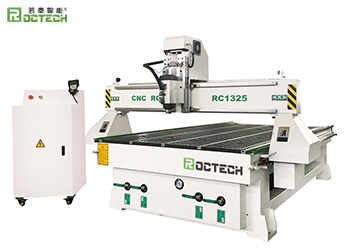
The data reveals a clear correlation between machine complexity and Industry 4.0 feature adoption. Nesting centers and five-axis machining centers, which serve high-value applications in custom furniture and mold making, exhibit the highest levels of IoT connectivity and predictive maintenance integration. In contrast, basic three-axis engraving machines—still widely used in small workshops—lag significantly, presenting both a challenge and an opportunity for vendors to offer upgrade paths.
Technology Applications and Brand Case: Roctech’s Industry 4.0 Alignment
The transition toward smart manufacturing is not merely about adding sensors or cloud connectivity; it requires a holistic rethinking of machine design, software architecture, and service models. Roctech Machinery Co., Ltd., headquartered in Jinan, Shandong, has positioned itself as a representative Chinese manufacturer bridging the gap between cost-effective CNC solutions and advanced automation. The company’s product roadmap explicitly targets Industry 4.0 readiness through several strategic initiatives.
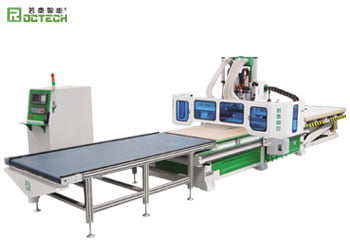
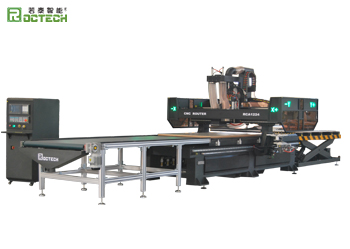
First, Roctech’s Master Series automatic loading and unloading nesting centers (e.g., RCA1224 and RCA1325) incorporate double-layer vacuum tables with zone control, automatic labeling systems, and compatibility with mainstream nesting software such as Haixun and 1010. These features directly address the “mass customization” paradigm—a core tenet of Industry 4.0—by enabling rapid changeover between different panel sizes and designs without manual intervention. The integration of Taiwan Syntec control systems, which support remote monitoring and G-code program management via Ethernet, provides the foundational layer for IoT connectivity.
Second, for complex geometry processing, Roctech’s RCF series five-axis simultaneous machining centers utilize Italian OSA
Looking for more information about our CNC machines and services? Contact us today.
Contact
Previous:The Evolution of Panel Furniture Cutting: Why Nesting Centers Are Redefining Production Efficiency
Next:Roctech RCE08: Redefining Efficiency in Compact CNC Woodworking Solutions