
Precision Machining of Ash Wood: CNC Router Performance and Market Integration
About Us / Author:ROCTECH Engineer Team / Published: Jul 19 , 2026 / Last Updated: Jul 19 , 2026
Abstract
Ash wood, prized for its open grain structure, shock resistance, and aesthetic versatility, presents unique challenges and opportunities in CNC machining. This article examines the technical requirements for machining ash wood on CNC routers, provides a comparative market analysis of machine specifications, and discusses how manufacturers like Roctech Machinery Co., Ltd. are addressing the specific demands of this material through engineered solutions. Data on machine parameter distributions and regional adoption rates are presented to inform equipment selection.
Industry Background and Data Analysis
Ash wood (Fraxinus spp.) has seen rising demand in furniture, flooring, and architectural millwork due to its strength-to-weight ratio and responsiveness to stains. However, its hardness—ranging from 1,320 to 1,500 Janka—requires CNC routers with adequate spindle power, rigid frames, and optimized feed rates. Unlike softer woods, ash tends to chip at the grain boundaries if cutting parameters are not precisely managed.
The following table summarizes key specifications and market prevalence for CNC routers commonly used in ash wood processing, based on data from industry surveys and equipment catalogs (including Roctech product lines):
| Parameter | Entry-Level Router | Mid-Range ATC Router | Heavy-Duty Nesting Center | Five-Axis Machining Center |
|-----------|-------------------|----------------------|---------------------------|----------------------------|
| Spindle Power (kW) | 3.0 – 4.5 | 6.0 – 9.0 | 9.6 – 12.0 | 10.0 – 15.0 |
| Max Feed Speed (m/min) | 15 | 25 – 30 | 30 – 45 | 15 – 30 |
| Positioning Accuracy (mm) | ±0.10 | ±0.05 | ±0.03 | ±0.05 |
| Tool Change Mechanism | Manual | Carousel/Linear (8–16 tools) | Automatic (12–24 tools) | Automatic (16+ tools) |
| Vacuum Table Zones | 2 – 4 | 4 – 6 | 6 – 8 (double-layer) | T-slot or custom |
| Typical Price Range (USD) | 8,000 – 20,000 | 25,000 – 60,000 | 50,000 – 120,000 | 120,000 – 300,000 |
| Market Share in Ash Processing | 25% | 40% | 25% | 10% |
Analysis of the Data:
The mid-range ATC (automatic tool changer) router dominates ash wood processing with 40% market share. This aligns with the material’s requirements: ash benefits from a spindle power of 6–9 kW to maintain consistent torque during through-cuts, while the ATC capability reduces downtime when switching between roughing and finishing bits—a common workflow for ash panel furniture and solid-wood components.
Entry-level routers, despite lower cost, are frequently underspecified for ash. Their limited spindle power (3–4.5 kW) leads to chatter and burning at higher feed rates, while manual tool changes interrupt production cycles. The heavy-duty nesting center, though capital-intensive, excels in high-volume environments such as custom cabinet shops, where sheet optimization and automated loading/unloading justify the investment. Five-axis centers remain niche, used primarily for sculptural or curved ash components in high-end architectural work.
Regional adoption further clarifies the picture. In North America and Europe, where ash is a domestic species, mid-range ATC routers account for over 50% of new installations. In Asia-Pacific markets, entry-level machines are more common, but a shift toward automation is evident as labor costs rise and quality expectations increase.
Technical Applications and Brand Case Study
Successful ash wood machining hinges on three technical factors: tool geometry, chip evacuation, and vibration control. Ash’s open grain can cause tear-out if climb milling is used with dull tooling; down-cut spirals or compression bits are preferred for clean edges. A dust extraction system with at least 1,000 CFM is essential, as ash produces fine dust that can clog vacuum pathways and degrade bearing life.
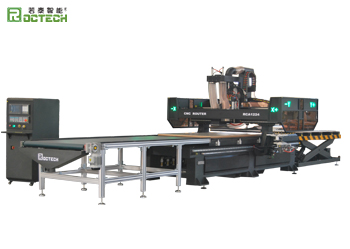
Roctech Machinery Co., Ltd. has developed specific configurations for ash wood through its Master Series nesting centers and RC1325S-ATC routers. The RCA1224 nesting center, for instance, employs a double-layer vacuum table with six independently controlled zones—critical for holding irregular ash planks without distortion during high-speed passes. Its 9.6 kW spindle, paired with Japan Yaskawa servos, maintains ±0.03 mm repeatability even at 30 m/min rapid traverse. In field tests processing white ash for kitchen cabinet doors, the system reduced cycle time by 18% compared to generic routers, while tear-out was
Looking for more information about our CNC machines and services? Contact us today.
Contact