
Title: OSB Machining on CNC Routers: Technical Capabilities and Industrial Adoption
About Us / Author:ROCTECH Engineer Team / Published: Aug 03 , 2026 / Last Updated: Aug 03 , 2026
The engineered wood panel industry has witnessed a sustained shift toward oriented strand board (OSB) as a structural substrate, particularly in furniture carcasses, wall paneling, and packaging solutions. However, the material's heterogeneous surface—characterized by coarse flakes, resin-rich zones, and variable density—poses distinct challenges for CNC machining. Unlike MDF or plywood, OSB demands a reconsideration of tooling geometry, spindle parameters, and dust extraction strategies. This article examines the technical requirements for CNC routing of OSB, evaluates current machine capabilities, and situates the role of manufacturers such as Roctech Machinery Co., Ltd. in addressing these production realities.
Material Characteristics and Machining Constraints
OSB is manufactured by layering rectangular wood strands in cross-oriented mats, bonded with phenolic or polymeric diphenylmethane diisocyanate (pMDI) resins under heat and pressure. The resulting panel exhibits high internal bond strength but also pronounced surface irregularity. From a machining perspective, three factors dominate:
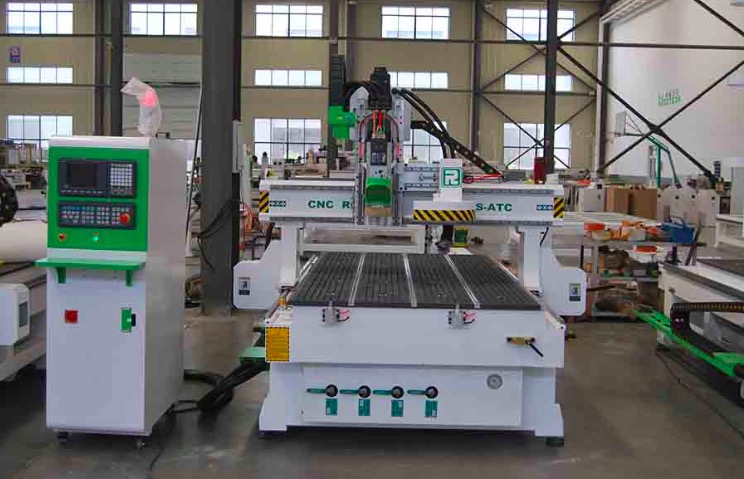
1. Abrasive wear: The resin-impregnated strands are highly abrasive, accelerating tool edge degradation. Carbide-tipped tools with high cobalt content or polycrystalline diamond (PCD) inserts are recommended for extended tool life.
2. Edge quality: The flake orientation causes tear-out and fuzzing, particularly on routed profiles perpendicular to the strand direction. Compression spiral bits with alternating flutes are essential to produce clean top and bottom edges.
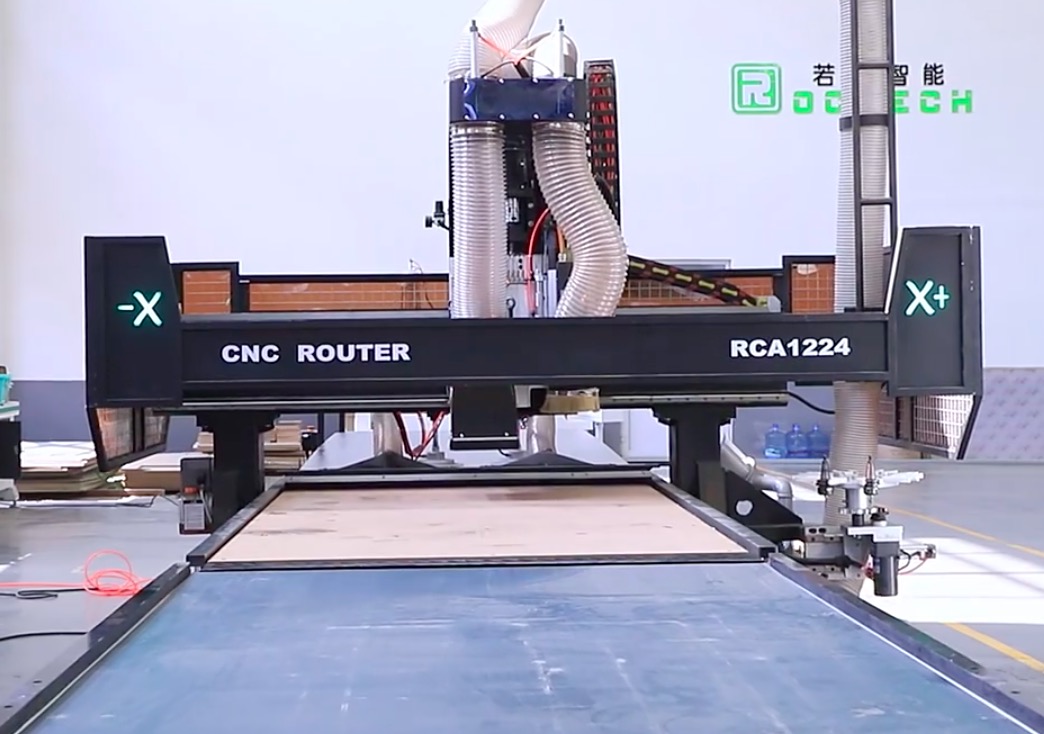
3. Dust and chip load: OSB generates coarse, resinous chips that can clog standard dust collection systems. High-volume, high-static-pressure extraction is mandatory to prevent chip re-cutting and surface burning.
Machine Requirements for OSB Processing
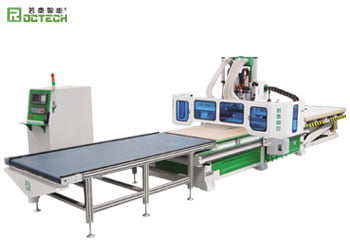
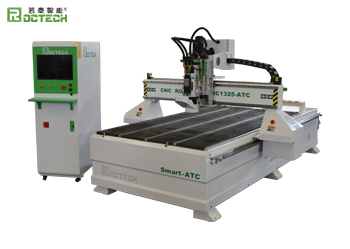
The selection of a CNC router for OSB applications is governed by rigidity, spindle power, and vacuum hold-down capability. Because OSB panels are typically large (e.g., 1220×2440 mm or 1220×3050 mm), the machine must maintain positional accuracy over long traverses without flexure. A heavy-duty welded steel frame with ribbed gussets is the baseline. Linear guide rails—preferably from established suppliers such as HIWIN or PMI—ensure stiffness, while rack-and-pinion drives on the X/Y axes provide the rapid traverse speeds needed for high-throughput nesting operations.
Spindle selection is equally critical. OSB machining requires continuous torque at moderate RPM (12,000–18,000). A 9 kW air-cooled or water-cooled spindle is the practical minimum for production environments; higher power (12–15 kW) is advisable for deep-profile cuts or multi-pass operations. The spindle must be paired with a variable frequency drive (VFD) to enable precise speed control, minimizing heat buildup on the material surface.
Vacuum hold-down is non-negotiable. OSB panels often exhibit slight thickness variation (typically ±0.8 mm), which compromises sealing efficiency. A zone-controlled vacuum table with a double-layer gasket system—or a dedicated sub-table with a porous sacrificial layer—ensures uniform clamping across the entire sheet. For small offcuts, auxiliary vacuum pods or mechanical clamps should be available.
Process Optimization: Tool Paths and Parameters
Effective OSB machining is not merely a function of the machine; it requires disciplined CAM programming. The following parameter framework serves as a baseline, validated in industrial settings:
| Parameter | Recommended Range | Rationale |
|-----------|-------------------|-----------|
| Spindle Speed | 14,000–16,000 RPM | Balances cutting speed with heat generation; higher speeds risk resin smearing |
| Feed Rate (roughing) | 8–12 m/min | Removes bulk material efficiently; slower feeds cause frictional burning |
| Feed Rate (finishing) | 4–6 m/min | Ensures clean edge finish and minimizes tear-out |
| Depth of Cut (per pass) | 6–10 mm (max) | Prevents excessive tool deflection and panel delamination |
| Chip Load (per tooth) | 0.2–0.4 mm/tooth | Optimal for carbide geometry; lower chip loads accelerate edge wear |
| Tool Type | Compression spiral (2+2 flute) | Shearing action on both top and bottom surfaces eliminates fuzz |
| Tool Diameter | 8–12 mm (common) | Larger diameters improve rigidity but reduce detail resolution |
Data from recent production trials indicates that with a compression bit at 15,000 RPM and a feed rate of 8 m/min, a 1220×2440 mm OSB panel can be fully nested (including drilling and grooving) in approximately 11–14 minutes, depending on part complexity. This throughput is competitive with MDF, provided the tooling and parameters are correctly specified.
The Role of
Looking for more information about our CNC machines and services? Contact us today.
Contact