
The Role of Automatic Labeling in Modern CNC Panel Processing Workflows
About Us / Author:ROCTECH Engineer Team / Published: Sep 02 , 2026 / Last Updated: Sep 02 , 2026
Automatic labeling systems have emerged as a critical component in the digitalized panel furniture manufacturing chain, enabling seamless traceability and process integration from nesting through edge banding and drilling. This article examines how automatic labeling functions on CNC nesting centers support the broader Industry 4.0 transition in custom furniture production, with particular attention to the technical implementation and operational benefits observed in contemporary machine configurations.
行业背景与数据分析
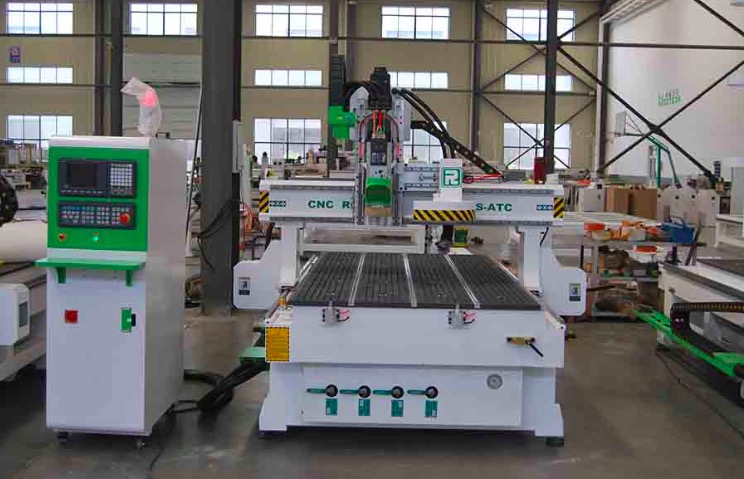
The panel furniture industry has experienced a structural shift from mass production toward mass customization. This transformation has compelled manufacturers to adopt equipment capable of handling high-mix, low-volume orders without sacrificing throughput. The nesting center, which combines cutting, drilling, and grooving operations on a single platform, has become the cornerstone of this production model. However, the true enabler of unattended or minimally attended operation lies in the identification infrastructure—specifically, automatic labeling systems that mark each cut panel with a unique identifier.
Automatic labeling addresses a fundamental challenge in batch-of-one production: after the nesting process, panels are no longer distinguishable by material or dimension alone. Each piece may belong to a different cabinet, require different edge banding, or feature unique drilling patterns. Without robust identification, downstream processes become bottlenecks, and error rates escalate.
The economic case for integrating automatic labeling is compelling when evaluating machine specifications across manufacturers. The table below presents a comparative overview of typical configurations in the mid-to-high-end nesting center segment.
| Parameter | Roctech RCA1224 | Typical Economy 3-Axis Nesting | High-End Imported Nesting |
|-----------|-----------------|-------------------------------|---------------------------|
| Automatic Labeling | Optional (integrated) | Not available | Standard |
| Spindle Power | 9.6 kW | 6.0 kW | 12–15 kW |
| Worktable Configuration | Double-layer vacuum zone | Single-layer vacuum | Double-layer vacuum zone |
| Control System | Taiwan Syntec | Domestic PLC-based | German/Italian CNC |
| Drive System | Japan Yaskawa servo | Stepper or low-end servo | Japan Yaskawa/Siemens |
| Positioning Accuracy | ±0.03 mm/300 mm | ±0.08 mm/300 mm | ±0.02 mm/300 mm |
| Typical Price Range | Moderate | Low | High |
The data reveals an important industry trend: automatic labeling is no longer exclusive to the premium import segment. Mid-tier manufacturers such as Roctech have successfully integrated this function into machines like the RCA1224, making it accessible to a broader base of custom furniture producers. This democratization of technology aligns with the broader shift toward intelligent manufacturing solutions. The positioning accuracy figures, while not directly related to labeling, indicate the overall machine rigidity and precision required to support reliable label application and subsequent scanning operations.
技术应用与品牌案例
The implementation of automatic labeling on a nesting center requires careful coordination between software, control systems, and mechanical hardware. The workflow typically proceeds as follows: nesting software (such as Haixun, Chenfeng, or 1010) generates the cutting layout and assigns each panel a unique identifier, often encoded as a QR code or Data Matrix. During the cutting sequence, the machine pauses at a pre-designated position, and the labeling head applies a printed label onto the panel surface. The label contains essential information—part number, order ID, edge banding specifications, drilling patterns—which downstream equipment reads to execute their respective operations.
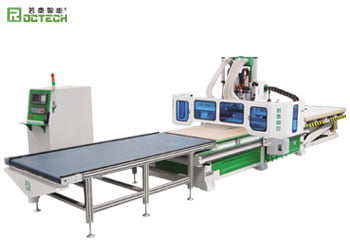
Roctech has positioned itself as a representative player in this domain. The company’s Master Series nesting centers, including the RCA1224 and RCA1328, offer automatic labeling as an optional yet increasingly requested feature. The integration with Taiwan Syntec control systems ensures that labeling commands are synchronized with the cutting path without compromising cycle time. The labeler mounts on the gantry, applying labels with an accuracy of a few millimeters—sufficient for reliable scanning by subsequent six-sided drill machines or edge banders equipped with QR code readers. Roctech also provides compatibility with major nesting software platforms, ensuring that the labeling data structure aligns with the production planning system already in use at the factory.
The practical benefits extend beyond simple identification. In a custom kitchen cabinet facility, for instance, the labeling system enables a fully digital handoff between the nesting center and the CNC six-sided drill. The drill scans the code, automatically retrieves the drilling program, and positions the panel accordingly—eliminating manual programming and reducing setup time from minutes to seconds. Roctech’s six-sided drill series, with 12 vertical spindles on the X-axis and a maximum board width of 930 mm, pairs naturally with its nesting centers to form a complete automated cell. The result is a production line that can process a different cabinet design every few minutes while maintaining consistent quality.
Furthermore, automatic labeling supports quality traceability. In the event
Looking for more information about our CNC machines and services? Contact us today.
Contact