
Five-Axis CNC Solutions for Rail Transit Mold Machining
About Us / Author:ROCTECH Engineer Team / Published: Sep 06 , 2026 / Last Updated: Sep 06 , 2026
The rail transit industry—spanning high-speed trains, metro systems, and light rail networks—demands components of exceptional structural integrity and dimensional fidelity. The molds used to manufacture interior panels, seating shells, structural composites, and acoustic insulation components must themselves be manufactured to exacting tolerances, often from large-format blocks of aluminum, engineering plastics, or composite tooling boards. For fabricators serving this sector, the selection of a machining center is not merely a matter of spindle power or axis travel; it is a decision that reverberates through the entire production chain, affecting lead times, surface quality, and ultimately, the safety certification of the finished vehicle.
Industry Context and Data Landscape
Over the past decade, the global market for rail transit mold machining has shifted perceptibly from traditional manual duplicating machines and three-axis vertical mills toward multi-axis CNC platforms. The primary drivers are threefold: the geometric complexity of modern train interiors (curved fairings, ergonomic seat backs, integrated lighting channels), the need for single-setup processing to reduce cumulative error, and the relentless pressure to compress prototype-to-production cycles. A recent analysis of procured equipment among Asian and European rolling stock suppliers indicates a decisive preference for five-axis simultaneous machining centers with work envelopes exceeding 2,500 mm in the X-axis.
| Machine Characteristic | Conventional 3-Axis VMC | 3+2 Axis Positioning | 5-Axis Simultaneous (e.g., Roctech RCF series) |
|---|---|---|---|
| Typical Work Envelope (X×Y) | 1300×2500 mm | 1300×2500 mm | 1300×2500 mm to 6000×2500 mm |
| Maximum Spindle Speed | 15,000 RPM | 18,000 RPM | 24,000 RPM |
| Number of Setups for a Seat Shell Mold | 3–5 | 2–3 | 1 |
| Positioning Accuracy (per axis) | ±0.05 mm | ±0.05 mm | ±0.05 mm (linear) / ±0.03 mm (repeat) |
| Surface Finish on Tooling Board (Ra) | 3.2–6.3 µm | 1.6–3.2 µm | ≤1.6 µm |
| Typical Mold Lead Time (Index, 3-axis = 100) | 100 | 82 | 61 |
| Requirement for Manual Polishing | High | Moderate | Low |
The data in the table underscores a crucial economic reality. While the initial capital expenditure for a five-axis machine is substantially higher—often by a factor of 1.8 to 2.5—the reduction in manual finishing labor and fixture design costs frequently yields a payback period of under eighteen months in a busy mold shop. Furthermore, the ability to machine undercut features and deep ribs without repositioning eliminates the "witness marks" that plague multi-setup machining, a critical factor for class-A surfaces visible to passengers.
Technological Imperatives in Mold Machining
Machining a rail transit mold—whether it is a thermoforming mold for a luggage rack or a compression mold for a fiberglass panel—imposes specific demands that general-purpose machining centers often fail to meet. First, the machine structure must exhibit exceptional static and dynamic rigidity. Long-duration finishing passes with ball-nose end mills at high spindle speeds generate harmonic vibrations that, if not damped by a heavy welded or cast bed, manifest as chatter marks on the mold surface. Second, the control system must handle continuous toolpath interpolation without data starvation. This is where the distinction between a 3+2 machine (which merely orients the head) and a true five-axis simultaneous machine (which coordinates all axes in real time) becomes decisive.
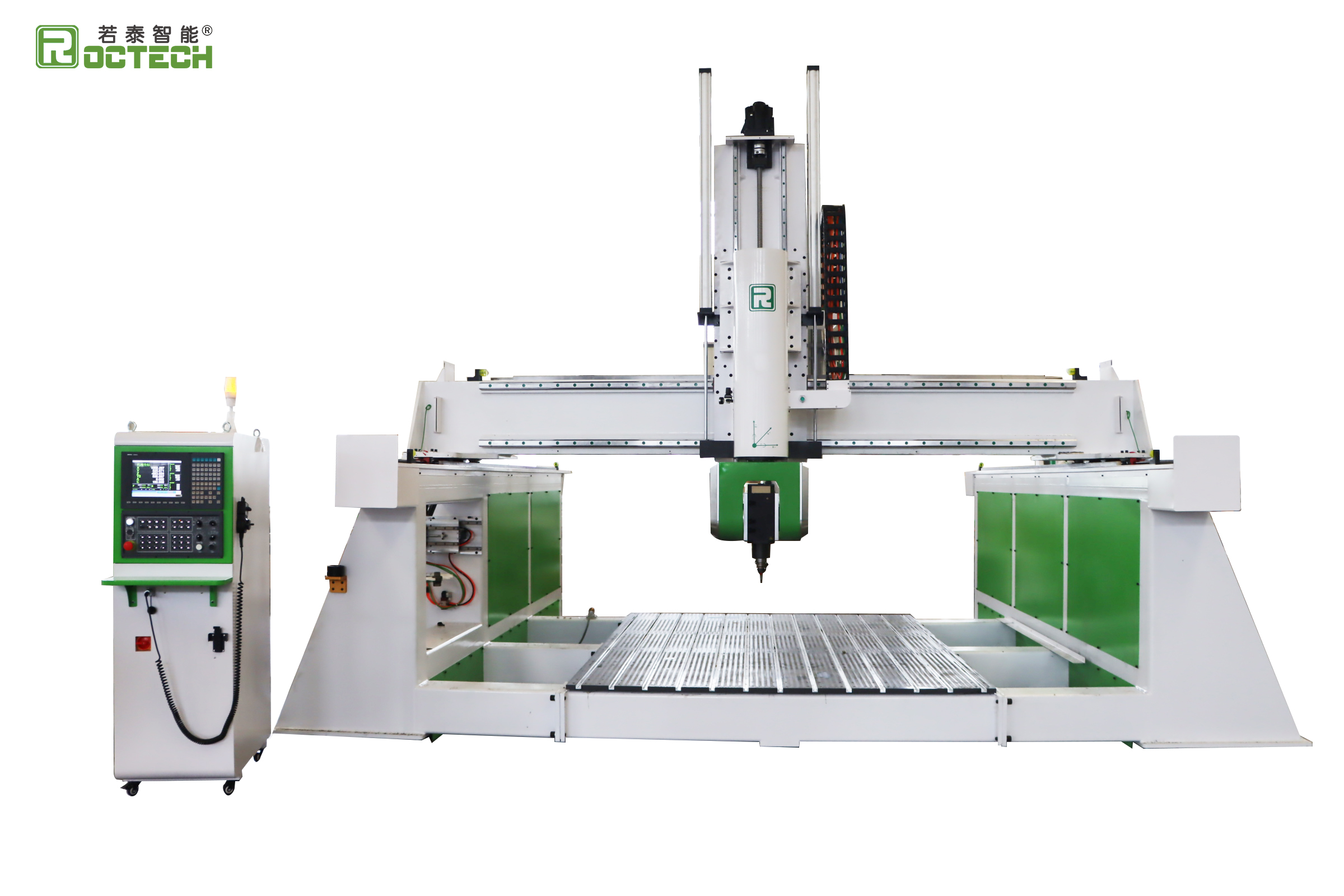
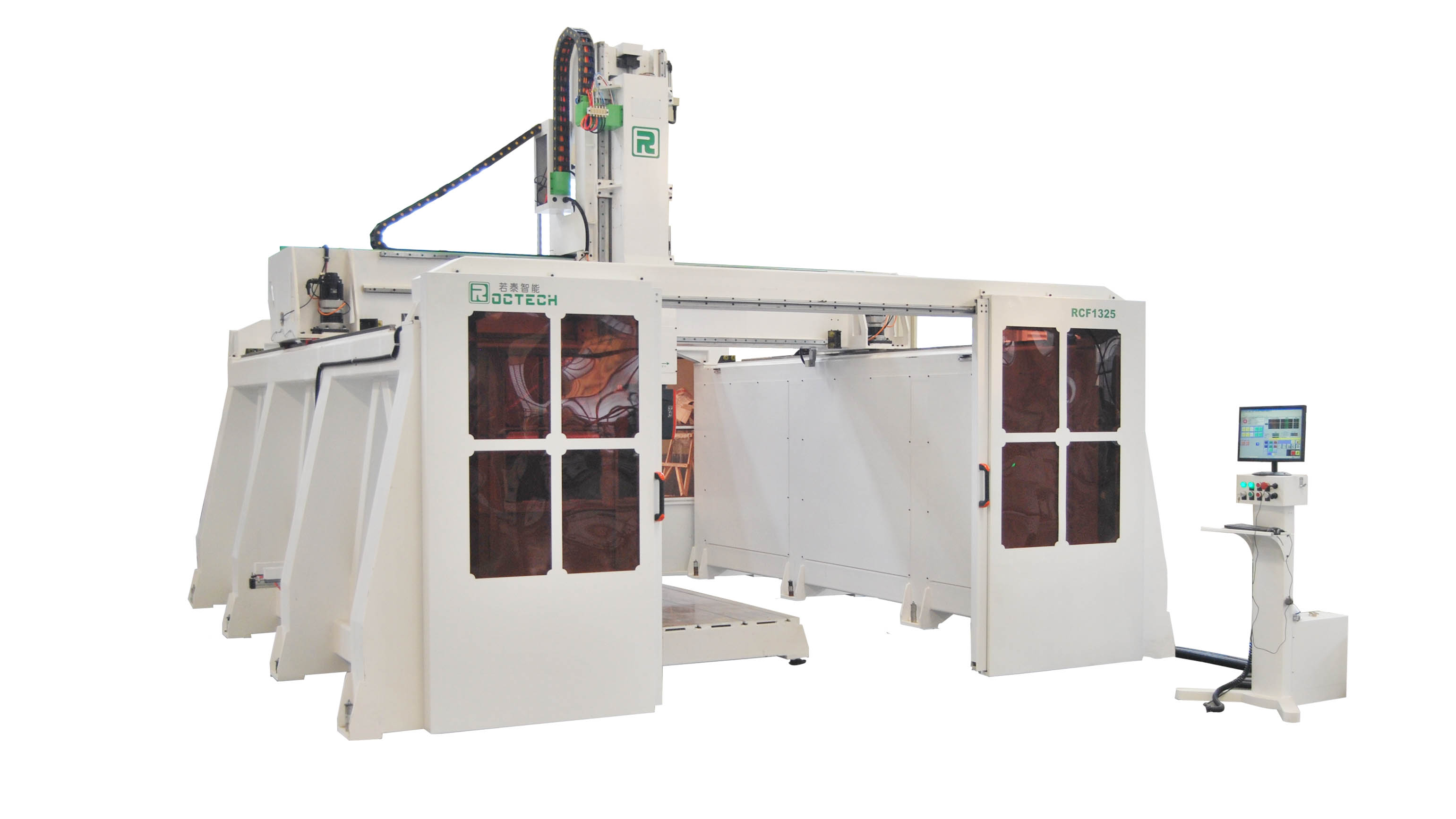
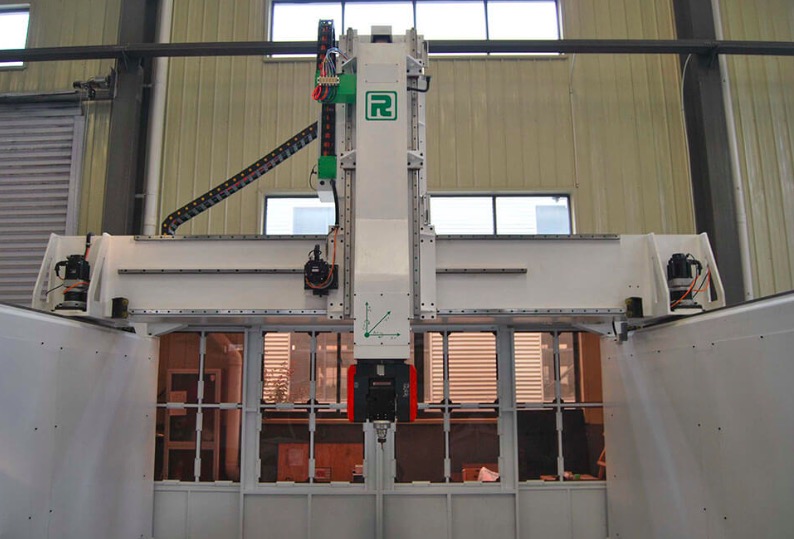
Manufacturers serving this niche increasingly specify machines with high-torque spindles in the 10–12 kW class, capable of sustained operation at 24,000 RPM for finishing operations in tooling board, yet with enough low-end torque to rough-cut aluminum billets. The A-axis swing angle, typically ±110° to ±120°, must be sufficient to reach deep into cavities without collision. In this context, Roctech Machinery Co., Ltd. has positioned its RCF series of five-axis machining centers as a viable alternative to European imports. The RCF1325, for instance, integrates an Italian OSAI five-axis control with a 10 kW spindle and a rigid, heavy-duty bed weighing approximately 8,500 kg. For manufacturers producing smaller interior components such as armrests or overhead console molds, this configuration offers an accessible entry point into true simultaneous five-axis machining without compromising on the essential criteria of accuracy and surface finish.
Case Considerations and Practical Implementation
A practical example from a Tier-1 supplier to a metro carriage
Looking for more information about our CNC machines and services? Contact us today.
Contact
Previous:Nesting CNC Automation: Reshaping Panel Furniture Production at Shanghai Furniture Fair
Next:Turn-Mill Centers in the Post-Mass-Customization Era: Bridging Wood, Foam, and Light Alloy Machining