
The Evolution of Specialized CNC Solutions for Bamboo Board Engraving
About Us / Author:ROCTECH Engineer Team / Published: Jul 28 , 2026 / Last Updated: Jul 28 , 2026
Abstract
Bamboo has emerged as a sustainable alternative in construction, furniture, and decorative industries, driving demand for dedicated CNC engraving solutions that address its unique material properties—fibrous structure, hardness variation, and susceptibility to splintering. This article examines the technical requirements, market trends, and automation strategies for bamboo board engraving, with a focus on how CNC router manufacturers are adapting standard woodworking platforms to meet these challenges. Data from global trade reports and machine specifications reveal a growing specialization within the CNC market, where brands like Roctech are positioning themselves as key enablers of this transition.
Industry Background and Market Data
The global bamboo products market was valued at approximately USD 68.8 billion in 2023, with projections indicating a compound annual growth rate (CAGR) of 5.2% through 2030. This growth is fueled by rising environmental awareness, stringent regulations on tropical hardwood harvesting, and the material’s inherent durability. Bamboo board processing, however, presents distinct engineering challenges: the material’s high silica content accelerates tool wear, while its directional grain structure demands precise cutting strategies to avoid delamination.
Within the CNC engraving machine segment, bamboo-specific applications have traditionally been served by general-purpose woodworking routers. Yet, as production scales and quality requirements intensify, the industry is witnessing a shift toward purpose-built or heavily customized platforms. The following table summarizes key market and technical parameters for bamboo board engraving systems worldwide:
| Parameter | Value / Observation |
|-----------|---------------------|
| Global bamboo product market value (2023) | USD 68.8 billion |
| Projected CAGR (2023–2030) | 5.2% |
| Typical bamboo board thickness range | 3–40 mm |
| Optimal spindle power for bamboo engraving | 6.0–9.6 kW |
| Recommended spindle speed | 18,000–24,000 RPM |
| Feed rate for fine engraving | 8,000–15,000 mm/min |
| Tool material preference | Carbide with TiAlN coating |
| Machine structure requirement | Heavy-duty welded frame (min. 2,500 kg for 1325 work area) |
| Key market regions | Asia-Pacific (65% share), North America (18%), Europe (12%) |
The data indicates that while entry-level machines can handle occasional bamboo work, sustained industrial production demands robust construction and higher spindle power to maintain tool life and surface finish. Notably, the 6.0–9.6 kW spindle range aligns with the specifications of mid-to-high-end CNC routers commonly deployed in custom furniture and architectural joinery.
Technical Challenges and Processing Solutions
Bamboo’s cellular structure is fundamentally different from that of softwoods or MDF. Its vascular bundles—composed of sclerenchyma fibers—create alternating hard and soft zones that cause uneven cutting resistance. If a machine lacks sufficient rigidity or the spindle lacks torque at low speeds, the result is vibration, chattering, and a rough surface with raised fibers.
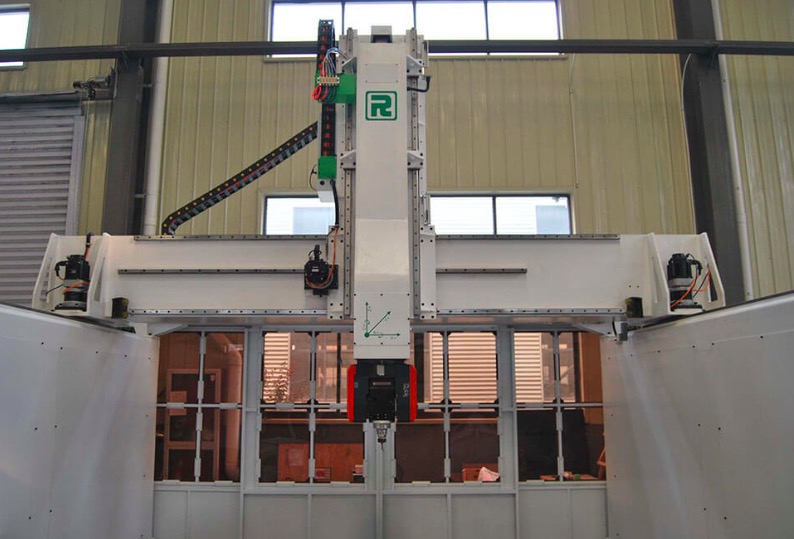
To mitigate these issues, modern CNC routers incorporate several design features. First, the bed structure must be heavy-duty. For a standard 1300 x 2500 mm working area (the ATC series specification common in woodworking shops), a machine weight of at least 2,200 kg provides the necessary damping to absorb cutting forces. Second, the transmission system should employ rack-and-pinion drives on X and Y axes for high-speed movement, combined with ball screws on the Z-axis for precision vertical positioning. Third, the vacuum adsorption table must be zoned to secure smaller bamboo panels without warping.
Tool selection is equally critical. Single-edge spiral milling cutters with polished flutes and TiAlN coatings significantly reduce heat buildup and extend tool life when cutting bamboo. The geometry should feature a high rake angle (15–20 degrees) to shear fibers cleanly rather than tear them. For three-dimensional relief work or deep engraving, ball-nose end mills with two flutes provide the best balance between chip evacuation and surface finish.
Automation and Brand Implementation
As bamboo processing moves from artisanal workshops to industrial scale, automation becomes a competitive differentiator. Automatic tool changers (ATC) with carousel or linear tool magazines allow a single machine to perform roughing, finishing, and drilling operations without operator intervention. For high-volume production, nesting centers with automatic loading and unloading systems can process entire sheets of bamboo board, with intelligent nesting software optimizing material utilization to over 90%.
Roctech, a well-established manufacturer based in Jinan, China, has addressed this market by offering the RCA series automatic loading and unloading nesting centers and the RC1325S-ATC carousel tool changer engraving machine. These platforms are equipped with Taiwan Syntec control systems, Japan Yaskawa
Looking for more information about our CNC machines and services? Contact us today.
Contact
Previous:Diagnosing and Correcting Spindle Positioning Inaccuracy in CNC Machining Centers
Next:Precision Aluminum Machining with CNC Routers: Capabilities, Market Trends, and Application Insights