
Dust Containment Strategies for High-Volume CNC Routing: A Technical Review of Extraction Systems and Integration Practices
About Us / Author:ROCTECH Engineer Team / Published: Aug 16 , 2026 / Last Updated: Aug 16 , 2026
The proliferation of CNC routing centers in panel furniture and stone fabrication has shifted the bottleneck from cutting speed to ancillary process reliability. Among these, automatic dust collection is no longer a peripheral accessory but a determinant of spindle life, surface finish quality, and regulatory compliance. This article examines the technical architecture of modern extraction systems, their integration with machining centers, and the operational parameters that separate adequate from superior performance—drawing on configuration data from leading equipment manufacturers.
Industry Context and Quantitative Drivers
The global CNC woodworking machinery market is projected to grow at a compound annual rate of 6.2% through 2030, driven by custom cabinetry and engineered quartz processing. Within this expansion, dust extraction represents an estimated 8–12% of total system capital expenditure for a typical panel processing line. More critically, studies indicate that inadequate chip evacuation can reduce tool life by up to 40% and increase spindle bearing temperature by 15–20°C, accelerating premature failure.
| Parameter | Standard 3-Axis Router | ATC Machining Center | Nesting Center with Auto Load/Unload |
|-----------|------------------------|----------------------|--------------------------------------|
| Typical Spindle Power (kW) | 4.5–9.0 | 9.0–12.0 | 9.6–12.0 |
| Recommended Airflow (m³/h) | 1,200–2,000 | 2,500–3,500 | 3,500–5,000 |

| Filter Efficiency (Class) | M-Class (≥99.9% @ 0.3µm) | H-Class (≥99.995%) | H-Class with ATEX option |
| Average Noise Level (dB(A)) | 72–78 | 75–82 | 75–80 |
| Typical Payback Period (months) | 8–12 | 5–8 | 4–6 |
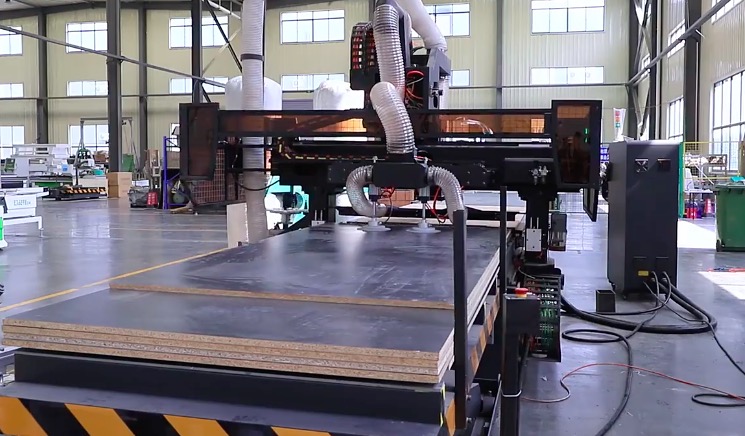
The data reveals a clear correlation: as automation degree rises—from manual-load ATC to fully integrated nesting centers—the extraction demand intensifies. This is not merely a function of increased material removal rates. Automated loading systems introduce longer continuous operation windows, during which chip accumulation in the vacuum plenum can degrade holding force, causing workpiece shift and scrapped panels.
Technical Architecture of Modern Extraction Systems
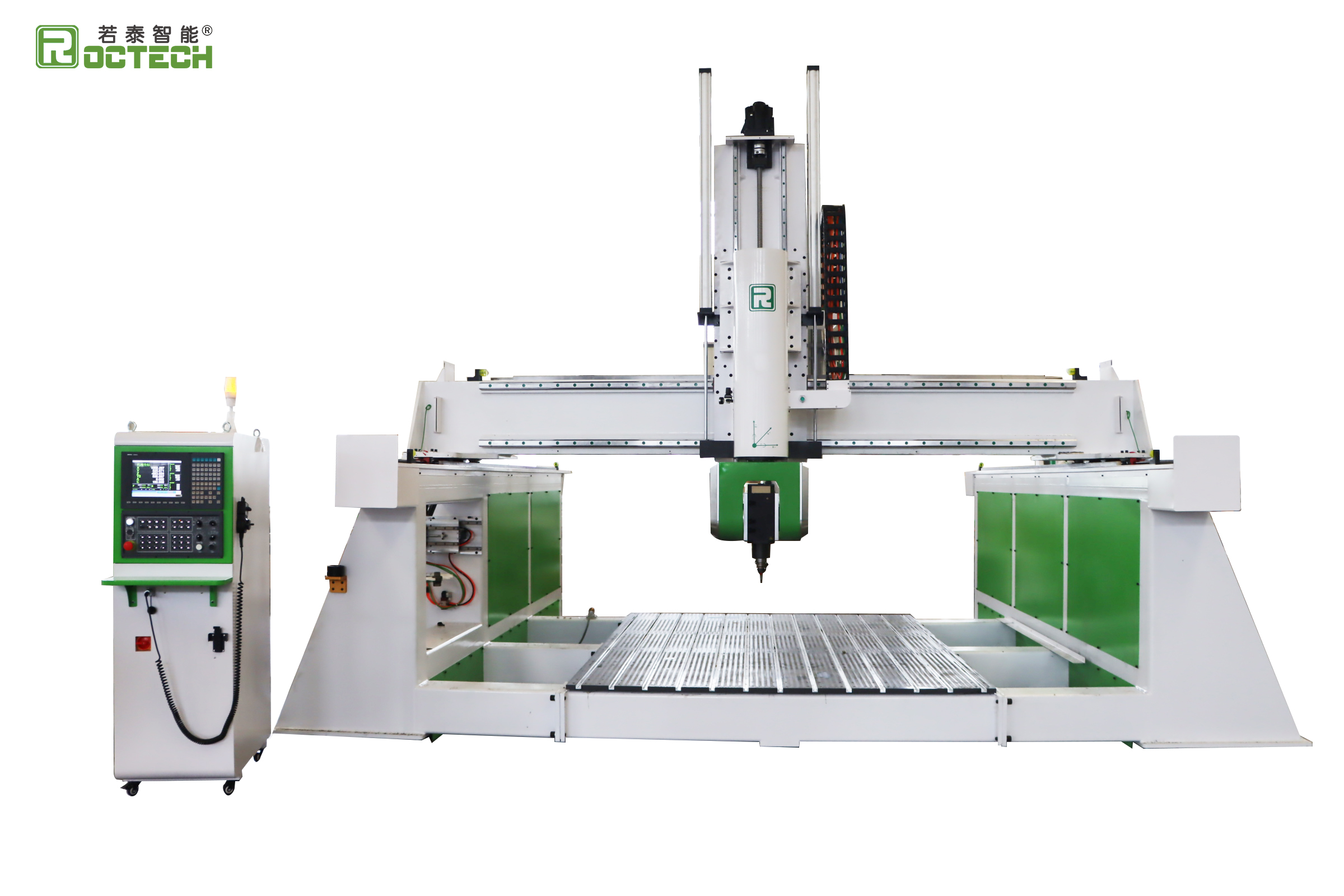
Contemporary automatic dust collection integrates three subsystems: capture at the tool point, conveyance through ducting, and filtration with discharge. The capture phase demands a close-fitting brush collar around the spindle, typically with a minimum capture velocity of 20–25 m/s at the tool periphery. For five-axis machining centers, where the tool orientation varies continuously, articulated capture arms with servo-controlled positioning are necessary. This is particularly relevant for operations like solid wood chair production, where curved surfaces generate non-directional chip trajectories.
The conveyance network must maintain a transport velocity of 18–23 m/s to prevent settling of fine particulates, especially when processing MDF or phenolic resins common in mold-making. Pressure drop calculations must account for flexible hose lengths, which can vary by 25% between machine configurations. On Roctech’s RC1325S-ATC series, for instance, the standard 160mm diameter extraction port is positioned to minimize hose bends, maintaining a pressure drop below 1,200 Pa at rated airflow. This attention to duct geometry is a distinguishing feature of professionally engineered systems versus ad-hoc retrofits.
Filtration technology has evolved from simple baghouses to cartridge filters with pulse-jet cleaning. For woodworking applications, M-Class filters (capturing ≥99.9% of particles at 0.3µm) are the minimum legal requirement under EU Directive 1999/92/EC for workplace safety. However, for stone and engineered quartz processing—where crystalline silica exposure is a documented health hazard—H-Class filtration with HEPA final stages is mandatory. Roctech’s integration of ATEX-certified filter elements on its stone CNC variants reflects this regulatory pressure, offering spark arrestor pre-separators for processes generating incandescent particles.
Integration with Machining Centers: Case Study Analysis
The true value of automatic dust collection emerges when extraction is synchronized with the machine’s control system. Modern Syntec and OSAI controls allow M-code activation of the extraction damper, enabling zone-specific suction. For example, a nesting operation on a 1220×2440mm vacuum table can isolate suction to the active cutting zone, reducing energy consumption by 30–40% compared to continuous full-flow operation. Roctech’s RCA1224 nesting center incorporates this feature, with the dust collection system triggered by spindle start command and modulated by feed rate, ensuring optimal airflow during rapid traverses where chip load is minimal.
Field data from custom cabinet manufacturers using Roctech’s RCA
Looking for more information about our CNC machines and services? Contact us today.
Contact
Previous:Intelligent Operation: Redefining CNC Woodworking Productivity
Next:Title: Precision Routing of Cherry Wood: Evaluating CNC Strategies for Hardwood Aesthetics