
Fiber Laser Cutting for Steel Plate: Precision, Throughput, and the Evolving Role of Integrated CNC Systems
About Us / Author:ROCTECH Engineer Team / Published: Aug 26 , 2026 / Last Updated: Aug 26 , 2026
The fabrication sector’s shift toward fiber laser technology for steel plate processing is no longer a question of if, but of how deeply and how quickly it can be integrated into existing production workflows. For decades, plasma and oxy-fuel cutting dominated heavy plate work, primarily due to lower capital expenditure. However, the sustained drop in fiber laser source costs, coupled with tangible gains in edge quality and kerf efficiency, has fundamentally altered the economic calculus for job shops and large-scale manufacturers alike. This analysis examines the current state of steel plate cutting machinery, with a focus on performance metrics, application-specific trade-offs, and the growing importance of a fully integrated, automated cell—an area where manufacturers like Roctech Machinery Co., Ltd. have positioned themselves as relevant turnkey suppliers.
Market Context and Technology Drivers
The global market for CNC cutting machines has seen a pronounced bifurcation. On one end, high-power fiber lasers (6kW to 12kW and above) are aggressively displacing plasma in the 10–25 mm mild steel segment. The reasons are technical and quantifiable: fiber lasers produce a cut face with a surface roughness (Ra) typically below 3.2 µm, eliminating most secondary grinding operations. On the other end, the entry-level segment is consolidating around 1.5–3 kW systems, which offer a compelling balance for shops cutting up to 6 mm sheet. The table below synthesizes current parameter benchmarks for typical steel plate laser cutting systems, based on industry-standard machine configurations (including those offered by Roctech’s fiber series).
Table 1: Comparative Performance Parameters for Fiber Laser Steel Plate Cutting Systems
| Parameter | 1.5 kW (Entry) | 3 kW (Mid-Range) | 6 kW (High-Volume) | 12 kW (Heavy Plate) |
|----------------------------|--------------------|--------------------|---------------------|----------------------|

| Max. Cutting Thickness (Mild Steel) | 8 mm | 16 mm | 25 mm | 40 mm |
| Max. Cutting Thickness (Stainless) | 4 mm | 8 mm | 12 mm | 20 mm |
| Positioning Accuracy | ±0.03 mm | ±0.03 mm | ±0.03 mm | ±0.02 mm |
| Repeat Positioning Accuracy | ±0.02 mm | ±0.02 mm | ±0.02 mm | ±0.01 mm |
| Max. Rapid Traverse Speed | 60 m/min | 80 m/min | 120 m/min | 140 m/min |
| Typical Kerf Width (6 mm MS) | 0.15 mm | 0.15 mm | 0.15 mm | 0.15 mm |
| Relative Operating Cost (per m cut) | 1.0x (Baseline) | 0.85x | 0.7x | 0.6x |
Source: Consolidated from industry spec sheets and Roctech product literature.
The data reveal a critical insight: while higher power reduces per-meter operating costs (due to faster speeds), it does not proportionally improve accuracy. The positioning accuracy plateaus at ±0.03 mm, meaning that for most structural fabrication jobs, the bottleneck is not the laser source but the mechanical rigidity of the gantry and the servo tuning. This is where machine design quality matters more than raw wattage. A 3 kW machine on a poorly damped frame will produce inferior parts to a 6 kW on a properly stress-relieved welded bed. For buyers, this underscores the need to evaluate the entire motion system, not just the laser resonator.
Application-Specific Considerations and System Integration
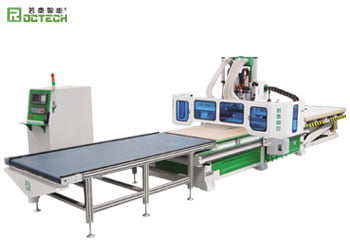
Choosing between a 3 kW and a 6 kW system is rarely a linear decision. For shops whose primary output is 3–8 mm mild steel (e.g., enclosure manufacturing, elevator components), a 3 kW machine offers a faster payback. However, shops processing 12–20 mm plate for construction machinery or shipbuilding will find the 6–12 kW class indispensable. The other significant variable is material handling. A bare-bones cutting table is no longer sufficient in labor-constrained markets. The shift toward automated loading/unloading, as seen in Roctech’s Master series for woodworking, has a direct parallel in metal fabrication. The integration of a fiber laser with a tower storage system and an automated part removal robot can reduce manual handling time by up to 60%, directly impacting throughput. Roctech’s 3015 and 4020 fiber platforms, for instance, are engineered with modular interfaces that allow for such peripherals to be retrofitted without significant re-engineering, a design philosophy that respects the capital constraints of mid-sized fabricators.
Looking for more information about our CNC machines and services? Contact us today.
Contact